

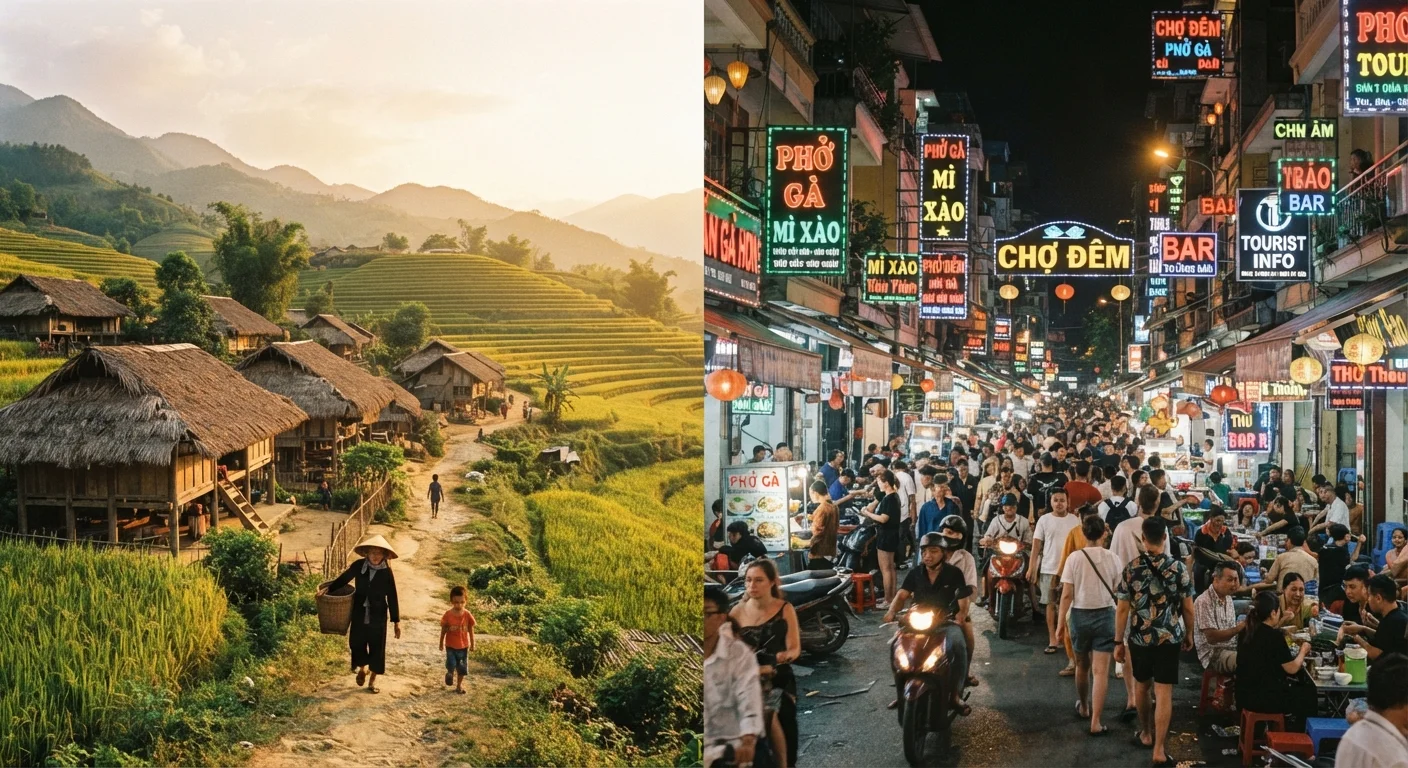
Key Takeaways
Our Verdict
Rural and urban cultural experiences are not competitors - they're complementary lenses. Rural settings slow you down and connect you to roots; cities accelerate your understanding of how those roots are being renegotiated in real time. Travelers who seek genuine cultural depth benefit most from intentionally experiencing both.
| Best for | Recommended |
|---|---|
| Travelers who want deep human connection and traditional ways of life | Rural cultural experiences |
| Those interested in contemporary art, politics, cuisine, and social change | Urban cultural experiences |
| First-time cultural travelers building confidence | Urban cultural experiences |
| Curious readers wanting the most complete picture of a country | Both, in sequence |
Two Windows, One Country
Ask someone what a country is really like, and you'll get a different answer depending on whether they spent their trip in a capital city or a rural village. Both answers are honest. Both are incomplete on their own.
A bustling metropolis and a quiet farming community belong to the same nation - they share history, language, and often cuisine - but they express those things in radically different ways. Understanding a place more fully means resisting the urge to pick just one window to look through. To learn how deep cultural immersion differs from typical sightseeing, see what cultural immersion really means.
What Rural Settings Teach You
Spend a few nights in a village homestay and something shifts. Life moves at a pace that isn't driven by notifications or schedules. Meals follow harvests. Conversations happen over shared labor. You start to absorb a culture's logic rather than just observing its surface.
Rural settings are where many countries' oldest traditions remain intact - agricultural rituals, oral histories, craft techniques, and seasonal ceremonies that have been adapted but not abandoned. These are the practices that shaped a society long before urbanization took hold.
Ask Before Photographing or Participating
In rural communities especially, everyday activities - a cooking fire, a family meal, a local ceremony - hold meaning that isn't always obvious to outside visitors. Always ask permission before taking photographs or joining in on traditions. A respectful approach opens more doors than any camera ever will.
There's also a lesson in interdependence. In many rural communities, neighbors' lives are genuinely intertwined - through shared water sources, communal land, or cooperative harvests. For travelers accustomed to urban anonymity, this kind of visible social fabric can be quietly revelatory. If you're curious about respectful participation in local rituals, attending cultural events as an outsider is worth reading before you go.
What Urban Settings Teach You
Cities are where a country argues with itself. Walk through a capital's neighborhoods and you'll find evidence of immigration waves, political upheaval, economic ambition, and cultural collision - sometimes all on the same block. Urban spaces are living records of change.
Street art, protest murals, multilingual menus, and rapidly shifting fashion districts all tell you how a society is negotiating its identity right now. That kind of contemporary cultural energy is nearly impossible to access in rural settings.
| Rural Cultural Experience | Urban Cultural Experience | |
|---|---|---|
| Pace of life | Slow, seasonal, community-driven | Fast, layered, opportunity-dense |
| Cultural depth | Traditional practices, oral histories | Contemporary identity, subcultures |
| Accessibility for beginners | Requires more preparation and flexibility | More infrastructure, easier entry points |
| Human connection | Intimate, often long-form interactions | Diverse but often brief encounters |
| What you'll see changing | Roots being preserved or quietly lost | How tradition is tested and remixed |
| Best for learning about | A country's foundation and values | A country's direction and tensions |
Cities also offer sheer density of access: museums, live music, food markets, universities, and communities from across the country and beyond. Street food especially can compress decades of culinary migration into a single market visit. And within cities, it pays to look beyond famous landmarks - exploring neighborhoods over landmarks often reveals far more honest portraits of daily life.
The Honest Trade-offs
Rural travel can involve real discomforts: limited infrastructure, language barriers without translation apps, and the vulnerability of being a visible outsider in a tight-knit community. These aren't reasons to avoid it - but they are reasons to prepare thoughtfully and go with genuine respect rather than cultural tourism instincts.
Urban travel carries its own blind spots. Cities can create a false sense of fluency. You find English menus, international hotels, and curated cultural experiences that are designed for visitors - which means it's easy to feel like you understand a place while still staying comfortably insulated from it. The challenge in cities is going deeper, not just covering more ground. Consider how independent travel compares to guided cultural tours when deciding how much structure you want around these experiences.
It's also worth reflecting on your presence as a traveler. Both rural and urban settings have communities that can be affected by tourism. Understanding overtourism helps you make more thoughtful choices about where and how you show up.
How to Sequence Both Experiences
If you're planning a trip that includes time in both environments, consider which to visit first based on your own temperament. Urban settings tend to offer more logistical support and easier onboarding - a good starting point if you're newer to international travel. Rural experiences often reward travelers who've already built some context about a country's history and culture.
That said, the reverse can be equally powerful: arriving in a village first, slowing down, and then carrying that grounded perspective into a city - where you'll suddenly notice all the ways urban life is in conversation with, or tension with, what you witnessed in the countryside.
Either way, the goal isn't to collect experiences. It's to let each place genuinely teach you something you didn't already know.
55%
World's population living in urban areas
According to the United Nations, more than half the global population now lives in cities - a figure expected to rise to nearly 70% by 2050, making rural ways of life increasingly distinct.
~3,500
Languages considered endangered worldwide
UNESCO estimates thousands of languages are at risk of disappearing, with many concentrated in rural communities - a reminder of what unique cultural knowledge rural settings still hold.