

| Budget starting point | Net income (take-home pay) |
| Fixed vs. variable | Fixed = same each month; Variable = changes each month |
| 50/30/20 split | 50% needs / 30% wants / 20% savings or debt (General personal finance guideline) |
| Sinking fund purpose | Save gradually for known future expenses |
| Zero-based budget goal | Every dollar assigned; income minus allocations = $0 |
| Discretionary spending | Wants, not needs - the most flexible budget category |
Why Budgeting Vocabulary Matters
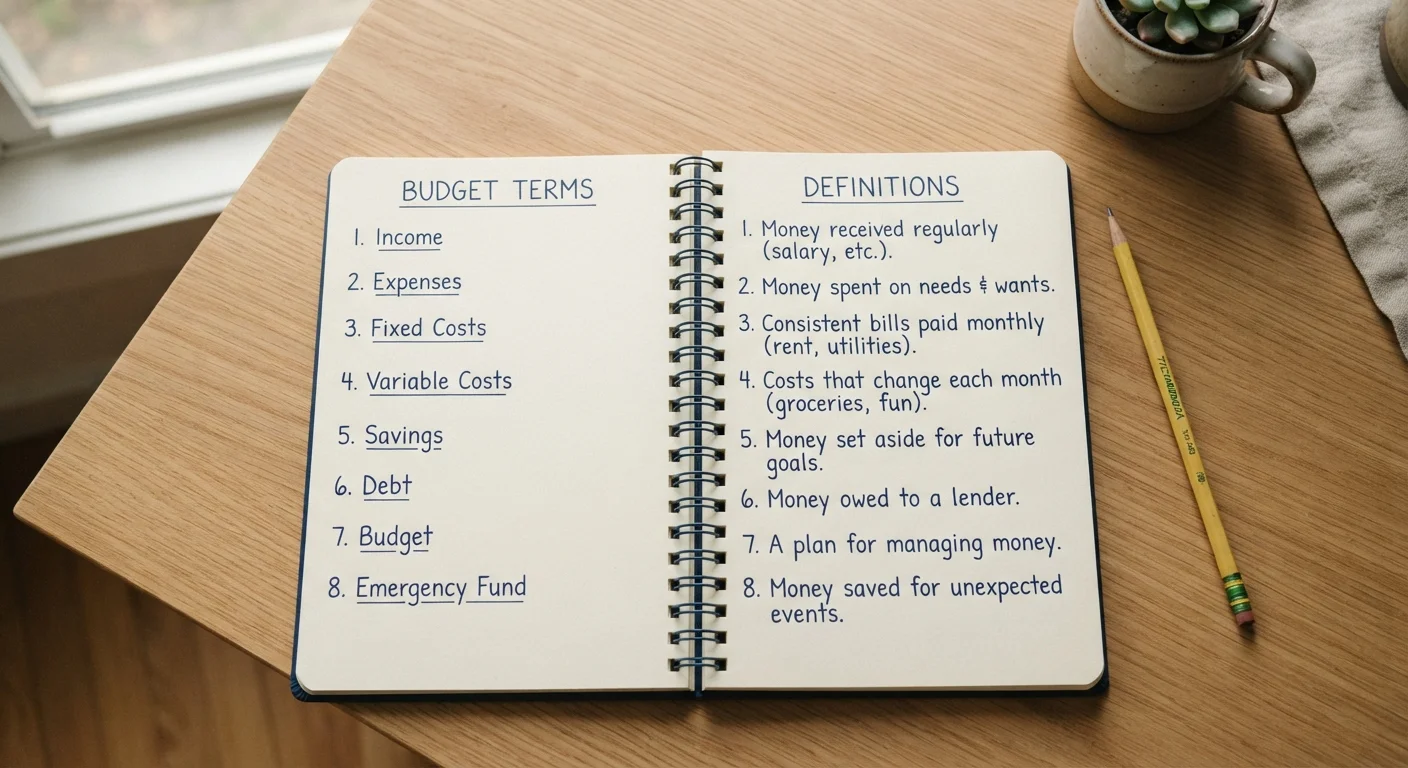
When you first try to build a budget, the terminology can feel like a barrier. Words like discretionary spending, sinking fund, and net income get thrown around as if everyone already knows what they mean. They don't have to be intimidating.
This glossary is a plain-English reference for the terms you're most likely to encounter when you start managing your money. Bookmark it, return to it, and use it alongside resources like Your First Budget in Seven Steps when you're ready to put these concepts into practice.
If you'd like a broader starting point, Personal Finance From Scratch: A Beginner's Map covers budgeting, saving, and financial awareness for complete newcomers.
Gross Income
The total amount you earn before any taxes or deductions are taken out. This is the number on your job offer letter or invoice - not what actually lands in your bank account.
Net Income
The money you actually take home after taxes, Social Security, Medicare, and any other payroll deductions are removed. Net income is the figure you should use when building a budget.
Fixed Expenses
Costs that stay the same amount every month, such as rent, a car payment, or a subscription with a set fee. Because they don't change, they're the easiest to plan around.
Variable Expenses
Costs that fluctuate from month to month, like groceries, gas, and utility bills. You can estimate these based on past spending but should expect some variation.
Discretionary Spending
Money spent on wants rather than needs - dining out, entertainment, hobbies, and similar choices. Reducing discretionary spending is often the first lever people pull when trying to free up money.
Budget Surplus
What remains when your income exceeds your total expenses for a given period. A surplus gives you room to save, pay down debt, or build an emergency fund.
Budget Deficit
When your total expenses exceed your income for a period. A recurring deficit means you're spending more than you earn, which typically leads to debt accumulation over time.
Emergency Fund
A dedicated savings reserve set aside to cover unexpected costs - a medical bill, a car repair, or sudden job loss. Financial educators commonly suggest keeping several months of essential expenses in this fund, though the right amount depends on individual circumstances.
Sinking Fund
A savings pool built gradually over time for a known future expense, such as a holiday, annual insurance premium, or home repair. Unlike an emergency fund, a sinking fund targets a specific, anticipated cost.
50/30/20 Rule
A popular budgeting guideline that suggests allocating roughly 50% of net income to needs, 30% to wants, and 20% to savings or debt repayment. It's a starting framework, not a strict rule, and may need adjusting based on income and cost of living.
Zero-Based Budget
A budgeting method where every dollar of income is assigned a specific purpose - expenses, savings, or debt payments - so that income minus all assignments equals zero. No money is left unplanned.
Debt-to-Income Ratio (DTI)
A calculation that compares your total monthly debt payments to your gross monthly income, expressed as a percentage. Lenders use DTI to assess how much of your income is already spoken for by existing obligations.
Key Terms at a Glance
| Budget starting point | Net income (take-home pay) |
| Fixed vs. variable | Fixed = same each month; Variable = changes each month |
| 50/30/20 split | 50% needs / 30% wants / 20% savings or debt (General personal finance guideline) |
| Sinking fund purpose | Save gradually for known future expenses |
| Zero-based budget goal | Every dollar assigned; income minus allocations = $0 |
| Discretionary spending | Wants, not needs - the most flexible budget category |
The terms above give you a high-level snapshot. The glossary section goes deeper - read the definitions in full before you start filling in your own numbers. If savings-related vocabulary is also new to you, the Savings Terminology Every Beginner Should Know glossary covers APY, compound interest, and more in the same plain-language format.
Once you're comfortable with the vocabulary, explore Zero-Based Budgeting vs the Envelope Method to see two beginner-friendly systems side by side. And if something has been stopping you from starting at all, Budgeting Myths That Keep People From Starting addresses the most common misconceptions head-on.
This article is for general informational purposes only and does not constitute personalized financial advice. For guidance specific to your situation, consider consulting a qualified financial professional.