

Key Takeaways
Why Paper Clutter Is Uniquely Stubborn
Unlike objects you can toss in a drawer, paper carries implied obligation - it might be a bill, a warranty, a form. That feeling of 'I should deal with this' is exactly why it piles up on counters instead of being filed. The solution isn't a more elaborate system; it's a minimal one. Most households only need three categories and a consistent weekly habit to stay clear.
Paper clutter also tends to be the tip of a wider organisation iceberg. If you're tackling other areas too, our guide to overlooked clutter zones covers spots most people miss entirely. And if you've been told you need dozens of bins or a full weekend clear-out to get organised, this breakdown of common decluttering myths is worth a read before you start.
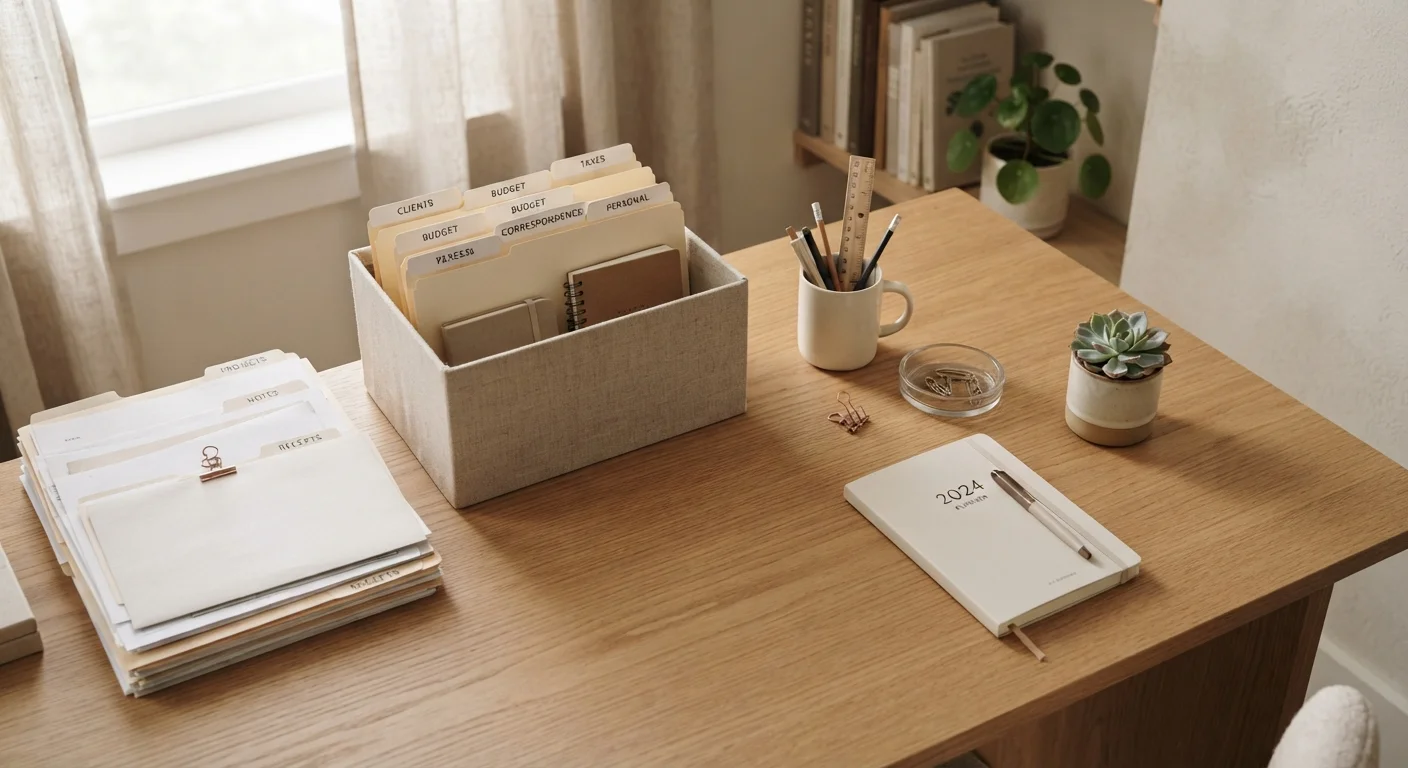
Accordion folder or small file box
Holds labeled sections for each paper category so documents stay upright and accessible.
Hanging file folders or manila folders
Divides categories into sub-sections for easy retrieval.
Label maker or sticky labels and a marker
Creates clear, readable tabs so every household member can navigate the system.
Recycling bin
Provides an immediate destination for junk mail, flyers, and duplicate papers.
Cross-cut shredder
Safely destroys documents containing personal or financial information before disposal.
Inbox tray
Serves as a designated landing spot for incoming papers before they are sorted.
Setting Up Your System Step by Step
The steps below are designed to work in a single sitting of under an hour. You don't need to purchase anything elaborate - a basic accordion folder available at most stationery or office supply stores is sufficient for the average household's paper volume. What matters is consistency of label and habit, not the quality of the folder.
Gather every loose piece of paper into one pile
Walk through each room and collect all papers - countertop stacks, drawers, bags, pockets, and pinned items on the fridge. Place everything in a single location, ideally on a cleared table. Do not sort yet; the goal here is to see the full scope of the problem at once. This prevents you from accidentally filing something you forgot about in another room.
Sort into three broad categories
Create three physical piles: Action (needs a response or task - bills to pay, forms to complete, invitations to RSVP), Archive (important records to keep - insurance, warranties, tax documents, medical summaries), and Discard (everything else). Place each sheet into one pile without overthinking; you can refine later. The three-pile method works because it matches how paper actually functions - it either needs something done, needs to be stored, or needs to leave.
Process the Discard pile immediately
Separate junk mail, outdated flyers, duplicate receipts, and old notices into two groups: recyclable and shred-worthy. Anything containing your name, address, account numbers, or identifying information should be shredded before recycling. This step removes the majority of the pile - most paper clutter is genuinely unwanted material that simply never had a clear exit point.
Set up labeled sections in your filing system
Take your accordion folder or file box and create labeled tabs for each sub-category within Action and Archive. Practical Archive labels include: Tax & Finance, Insurance, Medical, Home & Utilities, Warranties & Manuals, and Household Admin. For Action, a single tabbed section works - or divide it into To Pay, To Do, and To Contact. Keep labels broad rather than hyper-specific; over-categorising causes hesitation and delays during weekly maintenance.
File the Action and Archive piles into their sections
Work through each remaining pile and place documents into the appropriate labeled section. For Archive items, newer documents go at the front of each folder so the most recent version is always easiest to reach. Place the Action folder in an accessible, visible spot - a desktop inbox tray or a slot on your desk - so pending tasks stay top of mind rather than buried.
Create a landing zone for incoming paper
Designate a single spot - an inbox tray near the door or on the kitchen counter - where all new paper lands when it enters the home. This prevents future pile-up by giving paper one consistent entry point. The rule: nothing sits in this tray for more than one week. Every Sunday or Monday, spend five to ten minutes sorting the tray into your three categories and filing accordingly.
Go Digital Where It Makes Sense
Many bills, bank statements, and receipts can be switched to digital delivery, which eliminates the paper entirely. Scanning and saving key documents to a cloud folder is also a reliable backup for originals. However, some documents - property deeds, wills, passports, original contracts - should always be kept as physical copies in a secure location.
Once the system is in place, the complete guide to home organisation can help you apply the same logic to other areas of your home, room by room.
Shred Before You Recycle
Any document bearing your full name, address, date of birth, account numbers, or signatures should be shredded - not simply recycled. This includes old bank statements, insurance forms, medical letters, and pre-approved credit offers. A cross-cut shredder is significantly more secure than a strip-cut model.
Keeping the System Working Long-Term
The most common reason filing systems fail isn't a bad setup - it's an absence of a maintenance habit. A weekly ten-minute sort is the entire maintenance requirement. If the inbox tray fills faster than one session can clear it, that's usually a sign that incoming paper volume can be reduced at the source: unsubscribe from catalogues, switch accounts to paperless billing, and opt out of junk mail lists where possible.
Households with children face additional paper pressure - school letters, permission slips, artwork, and activity schedules. Organising around children requires slightly adjusted expectations and a dedicated 'kids' section in the Action folder. The same three-category logic still applies; you're simply adding one more sub-folder rather than rebuilding the system. For other areas of the home, the habit-building principles here translate well - see how they compare with maintaining a tidy wardrobe for a sense of how repeatable this approach is across different spaces.