

Key Takeaways
Why Home Organisation Matters (And Where Most People Go Wrong)
A disorganised home rarely stays that way by accident. Clutter tends to accumulate in predictable patterns - surfaces become default drop zones, storage fills with items that don't belong, and rooms gradually stop serving their intended purpose. The result is an environment that quietly increases mental load each time you walk through the door.
Research in environmental psychology consistently links cluttered environments with elevated stress and reduced ability to focus. A tidy, well-organised home, by contrast, supports clearer thinking and makes daily routines feel more manageable. If you've ever noticed feeling calmer after a clean-up session, that effect is real - not imagined. For more on managing that mental load, our grounding techniques guide offers practical strategies.
The most common mistake? Buying storage solutions first. Shelving units, bins, and drawer dividers solve nothing if they're filled with items you don't actually need. Organisation always begins with decisions about what to keep - not with a shopping trip.
54%
Americans overwhelmed by clutter at home
According to a survey by the National Association of Professional Organizers, more than half of American respondents described feeling overwhelmed by the amount of clutter in their homes.
40%
Of household items rarely or never used
Research from the National Soap and Detergent Association found that eliminating clutter could reduce housework in the average home by roughly 40%, largely because most stored items go unused.
The Foundational Principles of a Lasting System
Effective home organisation rests on a handful of durable principles that apply to every room and every household size.
- Declutter before you organise. Sort belongings into keep, donate, and discard categories. Handle each item once - hesitation is usually a sign you don't genuinely need it.
- Assign every item a home. Clutter is largely the result of objects without a designated place. When everything has a specific location, returning items becomes automatic.
- Group by function, not by type. Store things where you use them, not where they seem logically categorised. Charging cables belong near where you sit, not in a home office drawer across the house.
- Prioritise ease of return over ease of retrieval. If putting something away is harder than getting it out, it won't go back. Choose storage that makes returning items effortless.
- Scale your system to your actual life. A system built for an idealised version of your routine will fail within weeks. Design around your real habits, not aspirational ones.
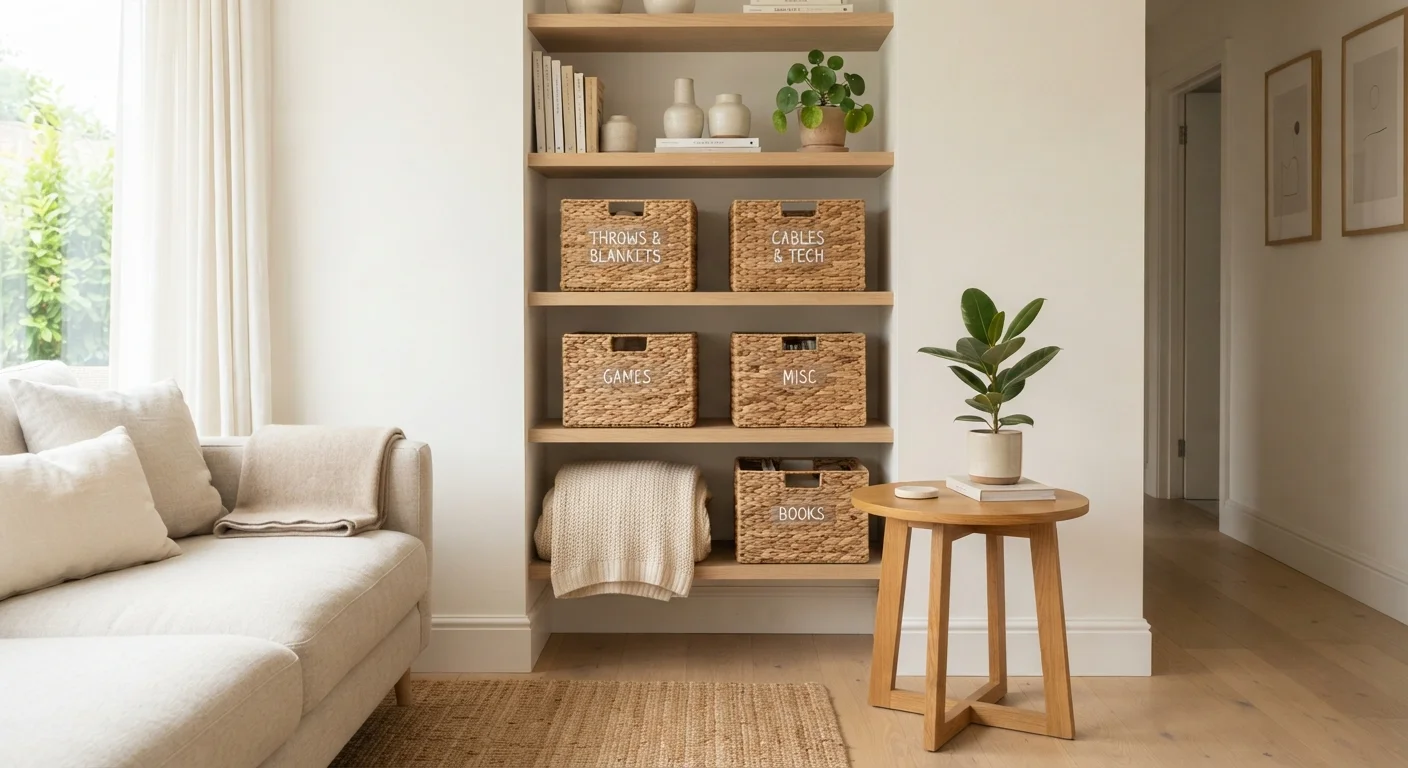
Label storage containers on the front face, not the top - you'll see the label when the container is on a shelf, which is where it spends most of its life.
Top-labelled bins are invisible when stacked or shelved, leading people to open every container to find what they need, which discourages the system over time.
When deciding whether to keep an item, ask 'would I buy this again today?' rather than 'do I use this?' - the first question cuts through sentimental justification more reliably.
The 'do I use this?' question often triggers memory-based justifications. The repurchase question reflects current, genuine utility rather than past intention.
Room-by-Room Organisation Strategies
Different rooms create different clutter patterns. Tailoring your approach to each space produces far better results than applying a one-size-fits-all method.
Kitchen
Group items by task: prep tools together, baking supplies together, daily-use items at the front of shelves. Clear countertops of anything not used daily - a single uncluttered surface makes cooking feel significantly less stressful. Store pots and pans vertically with dividers if space is limited.
Living Room
Identify the main clutter sources - remote controls, magazines, throws, charging cables - and create a dedicated container for each. A small basket beside the sofa handles most of it. Regularly reassess what belongs in communal space versus elsewhere in the home.
Bedroom
Treat the bedroom as a low-stimulus zone. Keep only sleep- and dressing-related items in the room. Under-bed storage works well for seasonal items in flat, labelled containers. A nightly two-minute surface reset prevents gradual accumulation.
Bathroom
Decant bulk products into smaller containers to reclaim shelf space. Discard expired products during your next clean. Use vertical space - over-door organisers and tiered shelving make a significant difference in small bathrooms.
Entryway
The entryway sets the tone for the whole home. Install hooks at a comfortable height for bags and coats. A shallow tray near the door corrals keys, cards, and small items that would otherwise disappear. See our room-by-room home maintenance checklist for a complementary overview of keeping each space in good working order.
Building Daily Habits That Stick
Organisation is not a one-time project - it's a set of repeated behaviours. The good news is that the habits required are genuinely small.
- The one-minute rule: If a task takes less than a minute, do it immediately rather than deferring it. This handles the majority of surface clutter before it builds.
- End-of-day reset: Spend five to ten minutes returning items to their designated homes before bed. This takes far less time than a weekend deep-clean.
- One-in, one-out: When a new item enters the home, something comparable leaves. This keeps volume stable without requiring periodic purges.
- Weekly zone check: Pick one area each week - a drawer, a shelf, a cupboard - and spend ten minutes reviewing what's in it. Small, regular attention prevents large-scale disorder.
If you're also doing home repairs and improvements alongside organising, our DIY Home Fixes hub covers beginner-friendly projects that complement a well-organised space. And if tools are part of your household, our guide on building your first toolbox will help you store them sensibly without over-buying.
Start With Just One Drawer
If the whole project feels overwhelming, begin with a single junk drawer or bathroom cabinet. Completing one small area creates genuine momentum and demonstrates that your approach works before you scale it up. Most people find that finishing one area motivates the next without requiring a full weekend commitment.
Common Mistakes to Avoid
Even motivated people run into predictable pitfalls when trying to get organised. Being aware of them in advance saves considerable time and frustration.
Avoid the 'Organising Spree' Trap
A one-off intensive organisation session feels productive but rarely produces lasting change on its own. Without small supporting habits, most spaces return to their previous state within weeks. Pair any big sort-out with at least one or two daily micro-habits to sustain the result.
- Organising without decluttering first. Neatly stored clutter is still clutter - just harder to address later.
- Creating systems too complex to maintain. Multi-step sorting systems work briefly, then collapse. Simpler is always more durable.
- Relying on visual reminders that fade. Labels fade, sticky notes fall, and good intentions wane. Build systems where the physical layout guides behaviour naturally.
- Treating organisation as a destination. A perfectly organised home at one moment will drift. The goal is a system that recovers quickly, not one that never shifts.
- Underestimating the entryway. Most household clutter enters through the front door. Solving organisation at the point of entry prevents much of the downstream disorder.
Further Resources to Keep You on Track
Getting organised is an ongoing process, and the right supporting resources make it far easier to maintain momentum. Whether you're tackling a specific room, improving your broader home environment, or creating more space for plants and greenery, there's always a logical next step.
If you share your space with pets, our guide on setting up a cat-friendly home pairs well with room-by-room organisation thinking. For those looking to extend their sense of order into outdoor spaces, our Garden Basics hub covers accessible ideas for both indoor and outdoor gardening that complement a tidy, intentional home.
Room-by-Room Home Maintenance Checklist
A beginner-friendly checklist covering every main room in your home so you can stay ahead of small problems before they grow. Pairs naturally with an organised home to keep everything in working order.
DIY Home Fixes Hub
Simple repairs and upgrades any beginner can tackle - a useful companion once your home is organised and you're ready to address minor improvements.
Garden Basics Hub
Beginner-friendly gardening ideas for indoor and outdoor spaces, including low-maintenance plants that add calm and greenery to an organised home environment.