

Key Takeaways
Why Standard Organisation Advice Often Fails Families
Most organisation guidance is written for adults living in predictable, mostly static environments. Children introduce a fundamentally different variable: constant, enthusiastic entropy. Toys migrate. Art supplies multiply. Yesterday's neatly folded clothes become tomorrow's floor pile. This isn't a discipline problem - it's physics.
The first step toward a workable system is releasing the idea that a tidy home should look a certain way. As our guide to decluttering myths explores, many popular organisation ideas simply don't hold up in real households. With children present, the bar shifts from always neat to reliably recoverable - and that's a genuinely useful shift.
Setting realistic expectations from the start protects you from frustration when the systems inevitably get tested.
Design Systems Children Can Actually Use
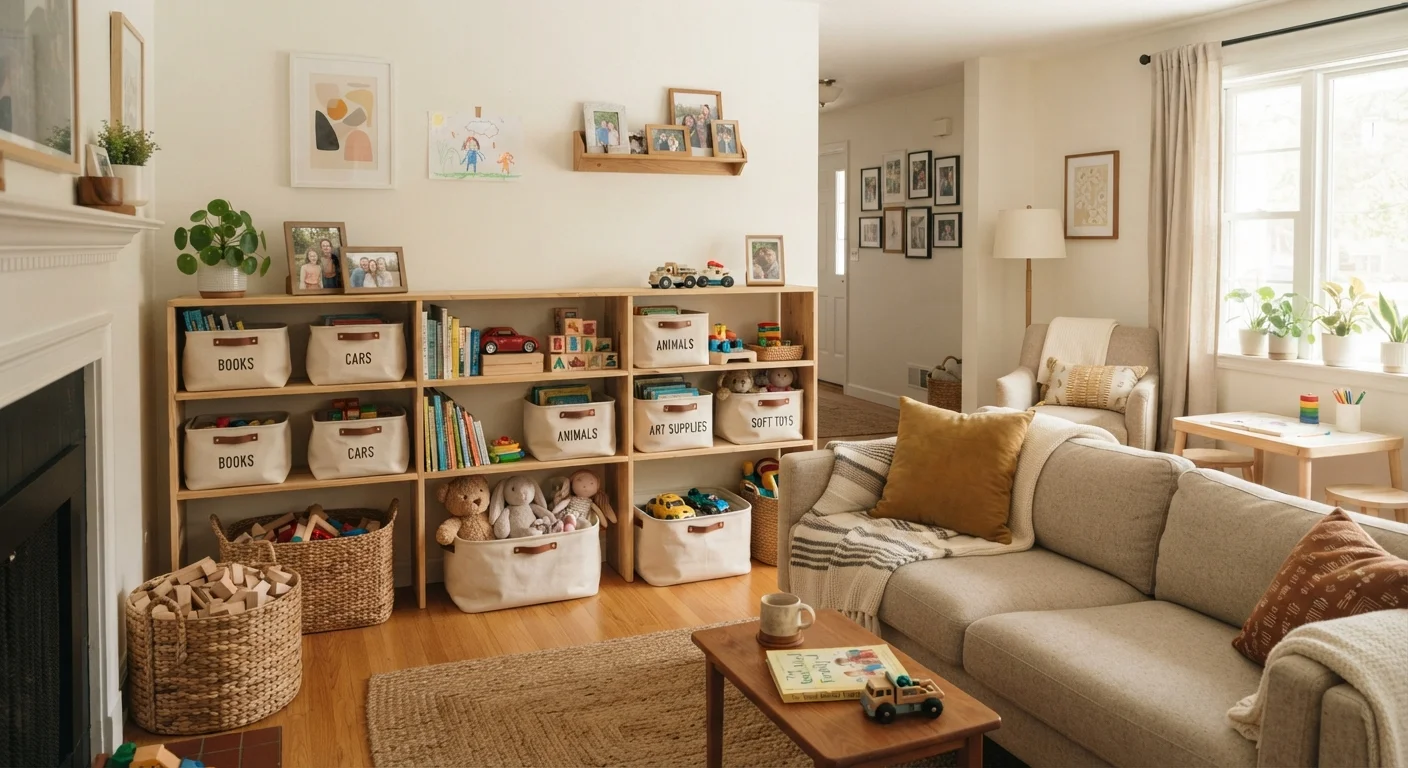
The single most important principle in family organisation is this: if a child can't use the system independently, it won't work. That means:
- Open containers over lidded ones. Lids require two steps. Open bins require one. Choose open bins, baskets, or trays wherever possible for children's belongings.
- Low and reachable storage. If a shelf is too high for a child to reach, they won't use it - and you'll become the permanent retrieval system.
- Visual labels. Picture labels or colour-coded bins work better than written labels for younger children, and they still help older ones move quickly.
The goal is to make putting things away just as easy as pulling them out. When the path of least resistance leads back to order, tidying becomes a habit rather than a chore.
Lower the barrier, not the standard
The difference between a system children use and one they ignore is almost always physical accessibility. Before retraining behaviour, check whether the system itself is genuinely easy to use: one-handed, at child height, with no steps that require adult assistance. Adjust the environment first, then address the habit.
For shared spaces where adults and children both need to access storage, our article on dedicated zones vs. flexible catch-all areas can help you weigh the trade-offs between structured and adaptable layouts.
Best Practices for Lasting Family Organisation
The following practices are grounded in what tends to work across different ages, household sizes, and temperaments - not perfection, but consistent forward motion.
Give every category of item one fixed home
When objects have a consistent location, children can return them without asking for help. Ambiguity about where something goes is the most common reason things end up on the floor or a random surface. A single, predictable home per category removes that ambiguity entirely.
Reduce the total number of items in active circulation
The more items competing for space, the faster any system collapses. Fewer things in daily use means less to tidy, less visual noise, and systems that stay intact longer. This applies to toys, books, clothes, and kitchen items alike.
Involve children in designing their own storage areas
Children who participate in setting up a system understand its logic and feel invested in maintaining it. Imposed systems are easier to ignore; co-created ones feel like theirs. Even young children can make meaningful choices about bin placement or label pictures.
Make tidying a group activity with a clear endpoint
Open-ended tasks feel overwhelming to children. A short, timed tidy with a clear finish - 'ten minutes, then we're done' - is manageable and motivating. It also prevents the chore from feeling indefinite or punitive.
Accept that some mess is a sign of a lived-in, functional home
Systems built for zero-mess maintenance are brittle; they fail on the first difficult week and can be hard to resume. Building in tolerance - a designated 'drop zone', a toy basket that doesn't need to be sorted daily - creates resilience without abandoning order entirely.
Build in Daily Resets, Not Overhauls
Rather than letting clutter accumulate until a weekend blitz is needed, short daily resets are far more effective in homes with children. A 10-15 minute tidy at the end of the day - ideally involving the children themselves - keeps mess from compounding.
Involving children in the reset routine is worth emphasising. When children help set up a system, they understand it, feel ownership over it, and are more likely to maintain it. This isn't about creating perfect little helpers - it's about building the habit loop of use, tidy, reset. If that loop becomes automatic, the system sustains itself even on chaotic days.
For households where different people have different tidiness expectations, the strategies in organising shared spaces with different standards offer a useful framework for negotiating shared areas without conflict.
Manage Volume Before You Manage Storage
No amount of clever organising solves the problem of simply having too much. Children's belongings, especially toys, tend to accumulate quickly through gifts, phases, and seasonal transitions. Before investing in storage solutions, reduce volume first.
~40%
Reduction in toys played with daily
Research from the University of Toledo found that toddlers engaged more creatively and for longer periods when presented with fewer toys at one time, suggesting that volume reduction actively benefits children's play quality.
10-15 min
Daily reset time in most family homes
Organisation researchers and household management practitioners consistently note that short daily maintenance sessions prevent the accumulation that makes larger periodic tidying feel overwhelming.
A rotating toy system - where a portion of toys is stored out of sight and swapped in every few weeks - can refresh interest without adding new items. It also means fewer things to manage at any one time, which makes tidying faster and less overwhelming for children. A seasonal reset checklist is a practical tool for reviewing what's accumulated and deciding what's still serving your household.
Expect systems to evolve with your children
What works for a four-year-old won't suit a nine-year-old. As children grow, their organisational needs, preferences, and capabilities change. Plan to revisit and adjust your systems at least once a year - a seasonal reset is a natural moment to do this. A system that no longer fits the child's age is one they'll stop using, so flexibility is built into the process, not a sign that something has failed.