

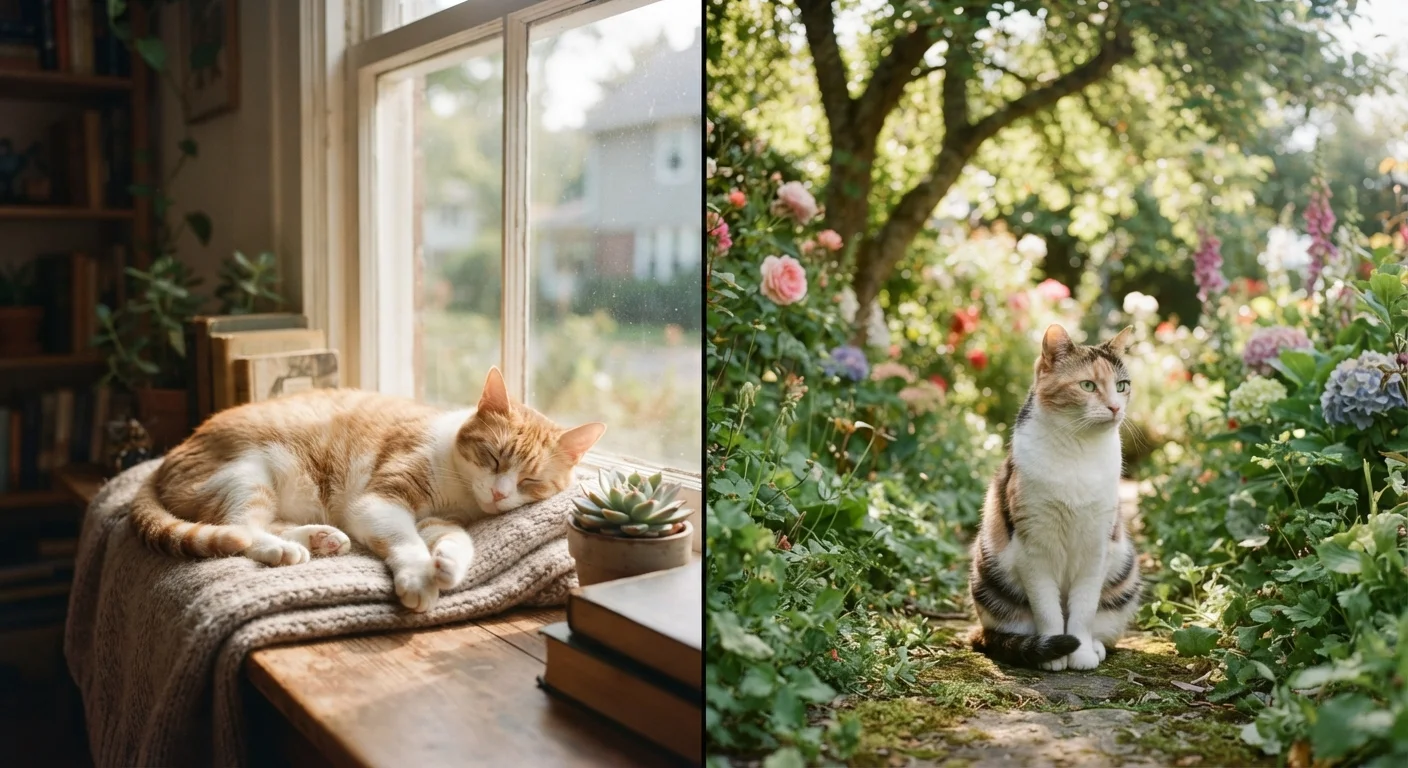
Key Takeaways
Option A
Indoor Cat
The protected, enrichment-dependent lifestyle.
Best for: Owners in urban or suburban environments who can commit to active mental and physical enrichment at home.
Option B
Outdoor Cat
The free-roaming, self-stimulating lifestyle.
Best for: Cats with strong roaming instincts living in low-traffic, low-predator rural areas with owners aware of the elevated risks.
If you live near busy roads or in a dense urban area
Indoor Cat
Traffic is one of the leading causes of injury and death in outdoor cats. A fully indoor life removes this risk entirely.
If your cat has a high prey drive and shows distress indoors
Outdoor Cat
Some cats with strong roaming instincts do not adapt well to confinement. Supervised outdoor access may support their wellbeing, though risks must be carefully weighed.
If you want the longest possible healthy lifespan for your cat
Indoor Cat
Research consistently associates indoor living with significantly longer average lifespans, primarily due to reduced exposure to injury and infectious disease.
If you want natural enrichment without full outdoor roaming
Indoor Cat
A well-designed indoor environment with a catio, window perches, and interactive play can satisfy most cats without outdoor exposure to hazards.
If you live in a rural area with low traffic and strong fencing
Outdoor Cat
Lower road traffic and space to roam reduce some key risks, though disease, wildlife encounters, and parasites remain genuine considerations.
The Core Safety Gap Between Indoor and Outdoor Life
The most consistent finding across veterinary and animal welfare research is that outdoor cats face a dramatically shorter average lifespan than their indoor counterparts. Estimates vary, but outdoor-only cats are often cited as living roughly half as long on average - a gap driven mainly by traffic accidents, attacks from other animals, infectious disease, and poisoning risks.
Indoor cats avoid the majority of these hazards. They won't encounter feline leukemia virus (FeLV) or feline immunodeficiency virus (FIV) through outdoor cat-to-cat contact, won't ingest toxic plants or chemicals from neighboring gardens, and won't be struck by a vehicle. For many owners, this safety advantage alone settles the question.
That said, safety isn't the whole picture. A cat kept indoors without adequate stimulation can develop anxiety, destructive behavior, or weight-related health problems. The physical and emotional needs of indoor cats are real and require active effort from owners to meet.
| Criterion | Indoor Cat | Outdoor Cat |
|---|---|---|
| Average lifespan | Typically longer | Often significantly shorter |
| Injury risk | Low | High (traffic, fights, falls) |
| Infectious disease exposure | Low | High (FeLV, FIV, URIs) |
| Parasite burden | Low | High (fleas, ticks, worms) |
| Natural enrichment | Must be provided by owner | Self-generated through roaming |
| Obesity risk | Higher without active play | Lower due to more movement |
| Owner supervision required | High (enrichment & activity) | Lower day-to-day, higher health monitoring |
| Impact on local wildlife | None | Can be significant (bird predation) |
Enrichment and Mental Wellbeing: Where Outdoor Life Has an Edge
Outdoor cats essentially self-enrich. Hunting, climbing, patrolling territory, and responding to new smells and sounds keep their minds active in ways that a static indoor environment cannot replicate passively. This is a genuine advantage - sensory variety matters for feline mental health.
Indoor cats depend entirely on their owners to provide that variety. Without it, boredom can manifest as over-grooming, aggression, or compulsive behaviors. The good news is that thoughtful enrichment goes a long way. Window perches with bird feeders outside, puzzle feeders, rotating toys, and regular interactive play sessions can meet most cats' needs. For cats that live alone, the stakes are higher - our guide on keeping a solo cat mentally stimulated covers practical strategies that work in everyday homes.
A growing middle-ground solution is the catio - an enclosed outdoor enclosure that allows cats to experience fresh air, sunlight, and outdoor sights and sounds without unsupervised roaming. Leash training is another option for calm, adaptable cats. Neither approach suits every cat, but both are worth considering before defaulting to fully free-roaming access.
10-15 years
Typical indoor cat lifespan
The American Veterinary Medical Association and animal welfare organizations commonly cite 10-15 years as the average range for well-cared-for indoor cats.
2-5 years
Estimated outdoor-only cat lifespan
Some veterinary and humane society sources estimate free-roaming outdoor cats live an average of 2-5 years, though this varies widely by environment.
~70%
Proportion of owned cats kept indoors (US)
Surveys from the American Pet Products Association have found a majority of owned US cats are kept primarily or entirely indoors.
Health Considerations Beyond Safety
Veterinary care requirements differ between the two lifestyles. Outdoor cats typically need more frequent parasite prevention - fleas, ticks, and intestinal worms are far more common when cats roam freely. They're also more likely to sustain wounds from fights or falls that require veterinary attention, and they're at higher risk of contracting upper respiratory infections from other cats.
Indoor cats, meanwhile, are more prone to obesity and the conditions associated with it - diabetes, joint problems, and urinary issues - largely because they move less and may be overfed. Portion control, appropriate diet, and daily play are the main tools for managing this. If you're weighing diet choices alongside lifestyle, our overview of wet food vs. dry food for cats can help you understand how moisture and caloric density factor in.
Regardless of lifestyle, all cats benefit from regular veterinary checkups, up-to-date vaccinations, and microchipping. Microchipping is especially important for outdoor cats, but indoor cats that escape - which happens - are also far more likely to be reunited with their owners if they're chipped. See what responsible cat ownership involves for a broader look at baseline care requirements.
The Middle-Ground Option: Supervised Outdoor Access
You don't have to choose between full indoor confinement and unrestricted outdoor roaming. Catios (enclosed outdoor runs), window boxes, and harness-and-leash walks offer cats outdoor sensory experiences in a controlled way. These options suit many cats well, particularly those showing signs of indoor restlessness, and they're increasingly recommended by veterinarians as a practical compromise.
Making the Decision for Your Cat
There's no universal right answer. The best choice depends on your cat's individual temperament, your geographic environment, and your capacity as an owner. A nervous, indoor-raised kitten will likely adapt contentedly to a stimulating indoor life. A cat with a strong prey drive that shows signs of frustration or persistent attempts to escape may genuinely need more outdoor access - though that access can often be structured and supervised rather than fully free-roaming.
Consider your surroundings honestly. Proximity to roads, presence of local wildlife predators, and neighborhood density all affect what outdoor access actually looks like for your cat. If leash walks or a catio are feasible additions, they can provide meaningful outdoor enrichment without the full risk profile of unsupervised roaming.
Whatever you decide, commit to meeting the needs that lifestyle creates. Indoor cat owners take on the responsibility of active enrichment. Outdoor cat owners take on the responsibility of monitoring for parasites, wounds, and disease exposure - and accepting a higher level of unpredictability. Neither path is passive.
This article provides general information for educational purposes and is not a substitute for advice from a qualified veterinarian familiar with your individual cat's health and circumstances.