

Key Takeaways
Why a Solo Cat Needs Active Enrichment
Cats are often labeled as independent animals, but that reputation can be misleading. While they may not crave constant contact the way some dogs do, cats are natural hunters with complex cognitive and sensory needs. A cat living alone without another feline to interact with relies entirely on its environment - and on you - to stay mentally engaged.
Boredom in cats doesn't always look obvious. Instead of acting out dramatically, many cats quietly withdraw, oversleep, overeat, or develop repetitive behaviors like excessive grooming. These can be early signals that life needs a little more stimulation. For a deeper look at what indoor cats need beyond the basics, see what cats actually need to thrive indoors.
The good news: you don't need to overhaul your home or your budget. Small, consistent changes to your cat's daily environment can make a significant difference. The tips below are practical, owner-tested, and designed to work in real homes.
Start with one change at a time
Introducing too many new enrichment elements at once can overwhelm some cats, especially those who are naturally cautious. Pick one idea from this list and give your cat a week to settle into it before adding another. Gradual changes tend to stick better for both owner and pet.
8 Ways to Keep Your Only Cat Mentally Stimulated
Make feeding time a puzzle
Replacing your cat's bowl with a puzzle feeder - or simply scattering kibble across a snuffle mat - turns mealtime into a foraging activity. This taps into a cat's natural hunting instinct and slows eating, which can also support healthy digestion. Start with easy puzzles and gradually increase difficulty as your cat gets the hang of it. Homemade versions using muffin tins or egg cartons work just as well as purpose-built feeders.
Foraging for food engages a cat's brain the same way hunting does in the wild.
Create vertical territory
Cats feel safest and most confident when they can observe their surroundings from height. Cat trees, wall-mounted shelves, and cleared bookcase tops all give your cat more usable space without expanding your floor plan. Vertical territory is especially valuable for solo cats because it lets them shift their environment throughout the day - resting up high, watching the room, then coming down to play. Check out our room-by-room guide to a cat-friendly home for specific placement ideas.
Vertical space gives cats a sense of control and security in their own home.
Offer a window perch with a view
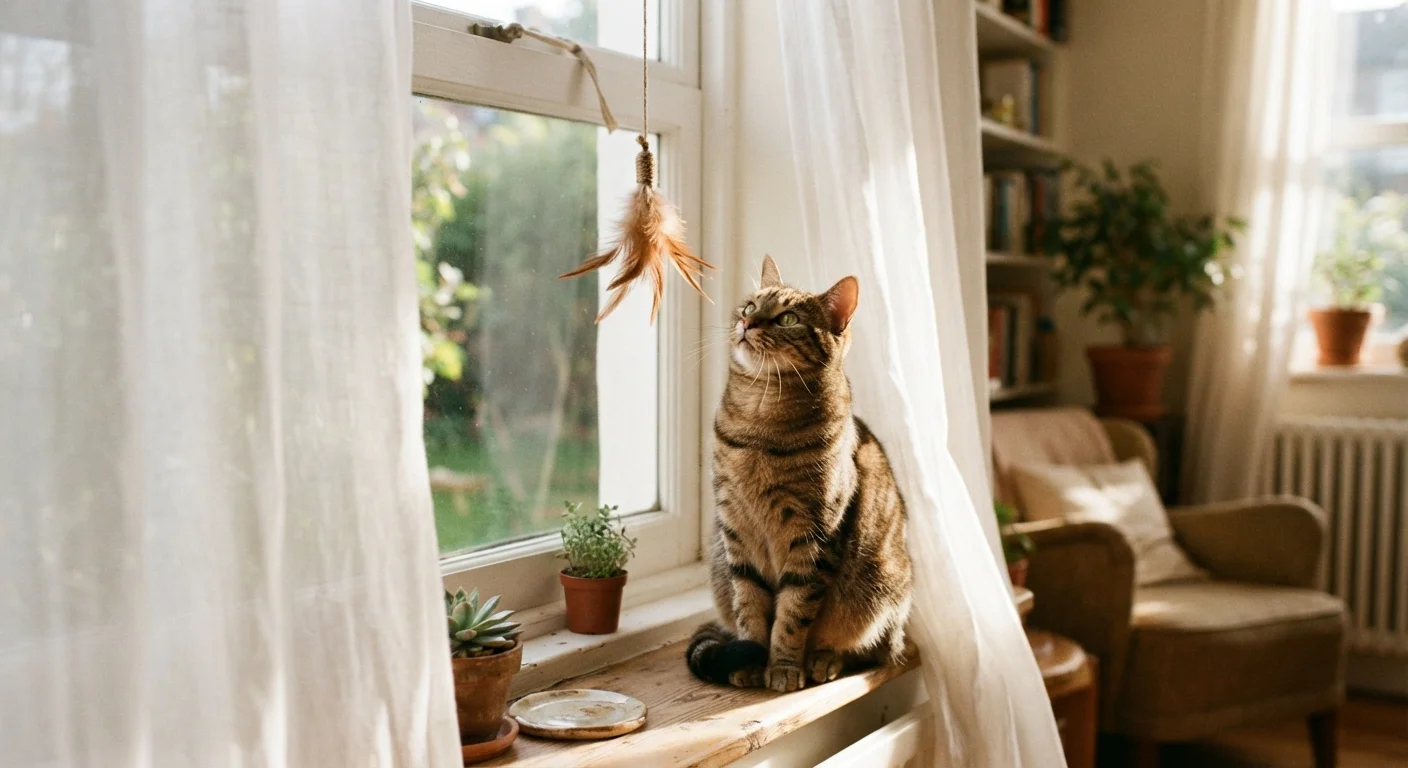
A sunny windowsill with a clear view of the outdoors functions like a television for cats. Bird feeders positioned outside a window, squirrels in a tree, or even passing pedestrians provide hours of visual stimulation at no ongoing cost. Add a comfortable perch pad to make the spot irresistible. This passive enrichment is especially valuable during the hours you're away from home.
A well-positioned window perch provides hours of free, passive mental stimulation.
Rotate toys on a weekly schedule
Cats habituate quickly - the toy that thrilled them on Monday may be invisible by Friday. Rather than buying more toys, try putting most of them away and rotating a small selection each week. When a toy reappears after a two-week absence, it often feels new again. Wand toys with interchangeable attachments are especially versatile because you can vary texture, movement, and sound with a single handle.
Rotating toys costs nothing and reliably refreshes your cat's interest in what they already have.
Schedule daily interactive play sessions
No amount of solo toys replaces the engagement of playing with you. Two 10-15 minute sessions per day - one in the morning and one in the evening - mirror a cat's natural activity peaks at dawn and dusk. Use a wand toy or feather teaser to mimic prey movement: slow creeping, sudden bursts, hiding behind objects. Always let your cat catch the "prey" occasionally so the session ends with a sense of success. Consistent play is one of the most impactful things you can do for a solo cat's wellbeing.
Daily interactive play mirrors a cat's natural hunt cycle and builds a genuine bond with their owner.
Introduce safe sensory variety
Smell is one of a cat's most powerful senses. Occasionally introducing new scents - a pinecone brought in from outside, a paper bag from the grocery store, or a small amount of dried catnip or silver vine - gives your cat something genuinely novel to investigate. Cardboard boxes and paper bags (handles removed for safety) also provide tactile exploration and a satisfying crinkle underfoot. These low-cost additions engage your cat's brain in ways that static toys cannot.
Novel scents and textures stimulate a cat's brain through one of their sharpest senses.
Try clicker training
Training isn't just for dogs. Cats can learn to sit, high-five, spin, and navigate obstacle courses using reward-based clicker training. Beyond the novelty of learning a trick, training sessions give your cat focused mental exercise and strengthen the bond between you. Keep sessions short - three to five minutes - and always end on a success. Many cats who seem disinterested in toys respond enthusiastically to the structure and reward of a training session.
Clicker training gives cats a mental workout while deepening trust with their owner.
Use audio and visual media thoughtfully
Videos designed for cats - featuring birds, squirrels, fish, or insects - can hold a solo cat's attention during quiet periods in the day. Some cats watch attentively; others ignore screens entirely. Let your cat's reaction guide how much you use this option. Similarly, leaving calm background sound (classical music or nature sounds) on during the day may reduce anxiety for cats prone to stress when left alone. These are supplementary tools, not replacements for physical and social engagement.
Cat-oriented video content can provide stimulation during the quieter hours of a solo cat's day.
Boredom vs. a behavioral health concern
If your cat shows sudden changes in behavior - such as significant withdrawal, compulsive grooming, or loss of appetite - these can sometimes signal a medical issue rather than simple boredom. Enrichment supports mental health, but it doesn't replace veterinary care. If you notice persistent or worsening behavioral changes, a visit to your vet is always the right first step.
Building a Richer Life for Your Solo Cat
Mental stimulation isn't a one-time setup - it's an ongoing practice. What works brilliantly one month might bore your cat the next, so staying curious about what engages them is part of the process. Rotate toys, rearrange climbing spots occasionally, and pay attention to which activities your cat returns to most eagerly.
If you're ever wondering whether a second cat might help, that's a valid question worth exploring carefully - introducing a second cat into a single-cat household requires patience and a phased approach. But many cats do thrive happily as solo pets when their environment is thoughtfully enriched. You're already on the right path by asking how to do better.