Key Takeaways
Option A
Whole Foods
Foods in their most natural, minimally altered state.
Best for: Building a nutrient-dense dietary foundation with fiber, vitamins, and minerals intact.
Option B
Processed Foods
Any food that has been altered from its original form.
Best for: Convenience, shelf stability, and affordability - though quality varies enormously across the spectrum.
If you're building healthier eating habits from scratch
Whole Foods
Starting with whole foods gives you a reliable nutritional baseline. They tend to be higher in fiber and lower in added sugars, sodium, and artificial additives.
If you need affordable, convenient everyday options
Processed Foods
Minimally processed items like canned legumes, frozen vegetables, and plain yogurt offer real nutritional value with the convenience of longer shelf life.
If you want to reduce ultra-processed food intake
Whole Foods
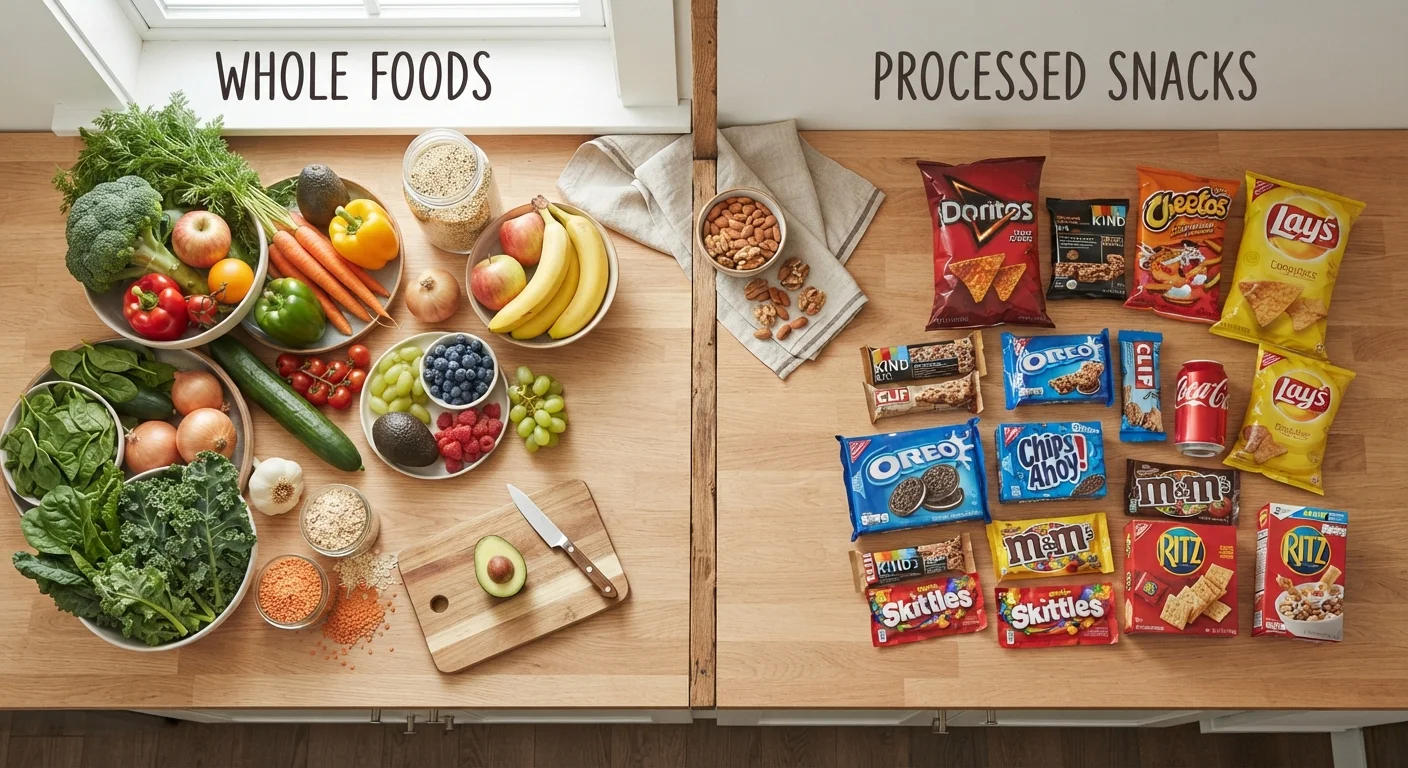
Swapping heavily processed snacks and packaged meals for whole-food alternatives is one of the most evidence-supported dietary adjustments available.
If you're managing a busy schedule and budget
Processed Foods
Thoughtfully chosen processed foods - oats, canned fish, frozen produce - can anchor a healthy diet without demanding extra time or money.
What 'Whole Food' Actually Means
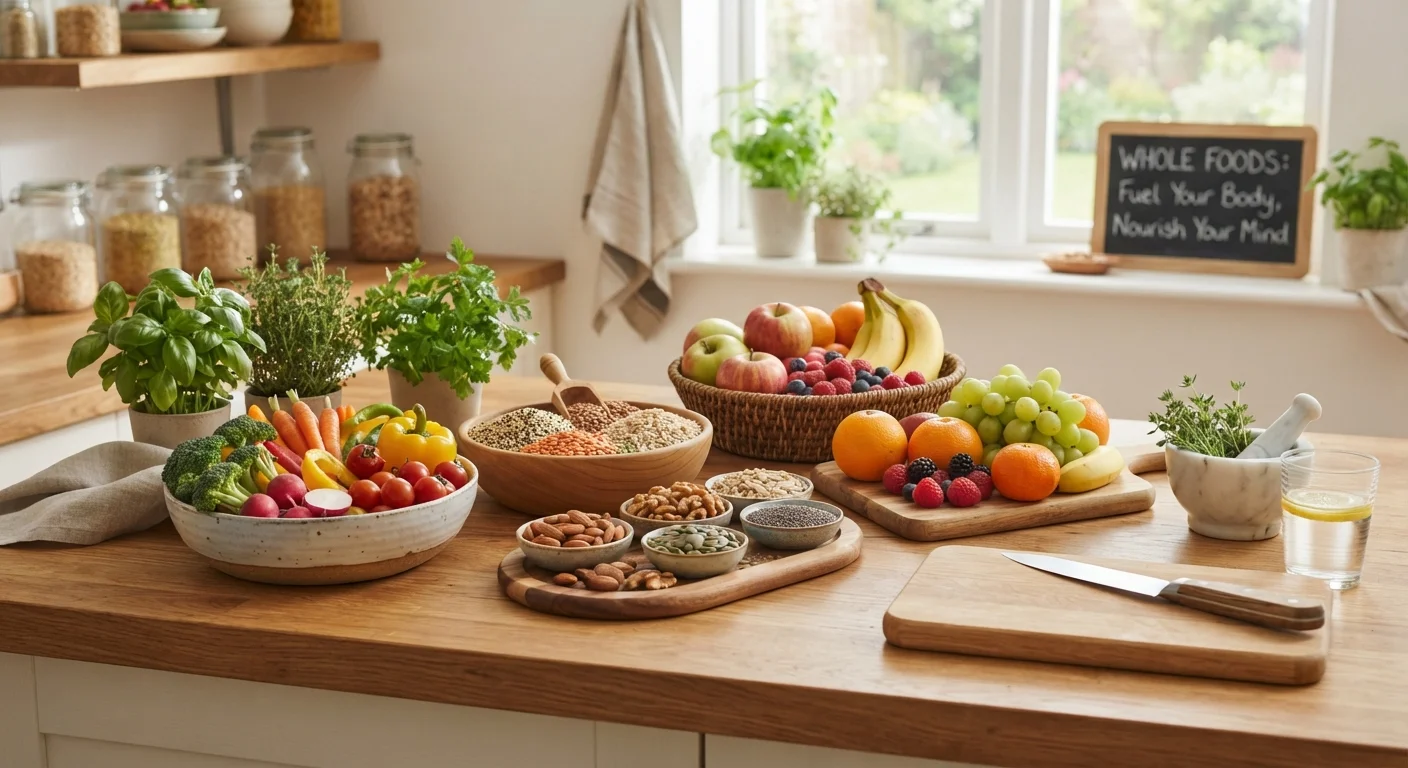
The term whole food refers to food that is eaten in, or very close to, its natural state - with minimal industrial alteration. Think of an apple, a handful of walnuts, a sweet potato, or a piece of salmon. The nutritional structure - fiber, vitamins, minerals, healthy fats - largely remains intact because little has been done to the food before it reaches your plate.
It's worth noting that "whole" doesn't mean "raw." Cooking a carrot or boiling lentils doesn't strip them of their whole-food status. The distinction is about the degree of industrial processing, not whether heat was applied in your kitchen.
Whole foods are particularly valued in nutrition for their fiber content - a nutrient that supports digestion and helps you feel full - and for the way their nutrients naturally work together in what researchers call a "food matrix." That matrix can influence how your body absorbs and uses what you eat.
The Wide Spectrum of Processed Foods
Here's where things get nuanced: processed food is not a single category. It's a spectrum. Nutritionists often use the NOVA classification system - a research framework developed to categorize foods by their degree and purpose of processing - to explain this range.
| Criterion | Whole Foods | Processed Foods |
|---|---|---|
| Definition | Minimally altered from natural state | Any food changed from its original form |
| Processing level | None to very minimal | Ranges from light to ultra-processed |
| Fiber content | Generally high and intact | Often reduced in highly processed versions |
| Added sugars & sodium | Absent or naturally low | Can be significant in ultra-processed items |
| Shelf life | Shorter; requires fresh storage | Often extended by preservation methods |
| Convenience | Moderate - prep time required | High - ready-to-eat options common |
| Cost | Varies; some items affordable in season | Often lower cost per serving |
At one end sit minimally processed foods: frozen spinach, plain rolled oats, pasteurized milk, canned chickpeas. These have been altered for safety or convenience but retain their core nutritional value. In the middle are processed culinary ingredients - olive oil, flour, salt - and processed foods like canned tomatoes in sauce or smoked fish.
At the far end sit ultra-processed foods (UPF): packaged snacks, sodas, reconstituted meat products, and many breakfast cereals. These are typically formulated from industrial ingredients - refined starches, added sugars, sodium, flavor compounds - rather than whole food components. Research, including large observational studies published in journals such as The BMJ, has linked high UPF consumption with increased risk of several chronic conditions. However, these are associations, not proven causes, and dietary patterns as a whole matter more than any single food.
Where the Real Nutritional Differences Show Up
When you compare a whole food to its ultra-processed counterpart, a few differences tend to stand out consistently:
- Fiber: Whole grains and vegetables contain naturally occurring fiber that is often stripped or reduced in refined, processed versions.
- Added sugars and sodium: Ultra-processed products frequently contain both in quantities that can add up quickly. Understanding added sugars is a helpful way to see how different they are from the sugars naturally present in fruit or dairy.
- Micronutrients: Some processing destroys heat-sensitive vitamins; other processing (like fortification) actually adds nutrients back in. It depends on the method.
- Calorie density: Ultra-processed foods are often engineered to be highly palatable and easy to overeat, partly because processing reduces their physical bulk.
57%
Share of US calories from ultra-processed foods
A study published in BMJ Open estimated that ultra-processed foods account for roughly 57% of energy intake in the average American diet.
~28g
Daily fiber recommended for adults
The 2020-2025 Dietary Guidelines for Americans identify dietary fiber as a nutrient of public health concern, with most adults falling well short of recommended intake.
None of this means processed food is uniformly "bad." Iodized salt and fortified cereals have historically addressed widespread nutritional deficiencies. Context matters.
Making Sense of This in Everyday Eating
For most people, a practical approach focuses less on rigid categorization and more on the overall quality of what's on the plate most of the time. A few evidence-informed starting points:
- Use minimally processed foods as your foundation. Frozen vegetables, dried legumes, plain whole grains, and fresh produce are all affordable, convenient, and nutritionally solid.
- Learn to read labels. When buying packaged food, the ingredients list tells you more than the front-of-pack claims. Reading a nutrition label without getting overwhelmed is a practical skill that pays off quickly.
- Watch out for health-halo marketing. Words like "natural," "organic," or "low-fat" don't automatically mean nutritionally superior. Some commonly labelled 'healthy' foods are worth examining more closely.
Frozen and Canned Count as Nutritious
Frozen vegetables are typically flash-frozen at peak ripeness, which preserves most of their nutritional value. Canned legumes and fish are similarly convenient and nutritious options. These minimally processed foods are a practical way to eat more whole foods without relying on constant fresh shopping.
Small, gradual shifts - adding a serving of vegetables, swapping a sugary drink for water - tend to be more sustainable than overhauling everything at once. The goal isn't dietary perfection; it's a pattern that works for your real life.
This article is for general informational and educational purposes only. It is not a substitute for professional medical or nutritional advice. Please consult a qualified healthcare provider or registered dietitian before making significant changes to your diet, especially if you have an existing health condition.