

Key Takeaways
Option A
Zero-Based Budgeting
The structured, every-dollar-has-a-job approach.
Best for: People who want complete control over every dollar and are comfortable planning on paper or in a spreadsheet.
Option B
The Envelope Method
The hands-on, cash-in-hand spending plan.
Best for: Tactile learners and overspenders who need a physical limit to curb impulse purchases.
If you want total visibility into every spending category
Zero-Based Budgeting
Zero-based budgeting forces you to plan every dollar deliberately, leaving no money unaccounted for at month's end.
If you tend to overspend and need a hard stop
The Envelope Method
When the envelope is empty, spending stops - no willpower required, no mental math needed.
If you prefer digital tools and bank transfers over cash
Zero-Based Budgeting
Zero-based budgeting translates naturally to spreadsheets and budgeting apps without requiring you to handle physical cash.
If you are a visual or hands-on learner new to budgeting
The Envelope Method
Physically sorting cash into labeled envelopes makes abstract spending categories concrete and easy to understand.
If you want to combine structure with real-time spending limits
Zero-Based Budgeting
Zero-based budgeting can incorporate envelope-style category caps while still working within a fully digital workflow.
What Is Zero-Based Budgeting?
Zero-based budgeting (ZBB) is a method where you assign every dollar of your monthly take-home pay to a specific category - housing, groceries, savings, debt repayment, entertainment - until you reach zero dollars left to allocate. Zero doesn't mean you spend everything; it means every dollar has an intentional destination, including money you plan to save.
Here's a simple example: if you bring home $3,000 a month, your budget categories must add up to exactly $3,000. If they only add up to $2,800, you decide what the remaining $200 is for - perhaps an emergency fund or a sinking fund (money set aside in advance for a predictable future expense). For a plain-English definition of terms like these, see the budgeting glossary.
ZBB is done on paper, in a spreadsheet, or through a budgeting app. You revisit and rebuild the plan each month, which keeps it current but does require a regular time commitment - typically 30 to 60 minutes at the start of each pay cycle.
What Is the Envelope Method?
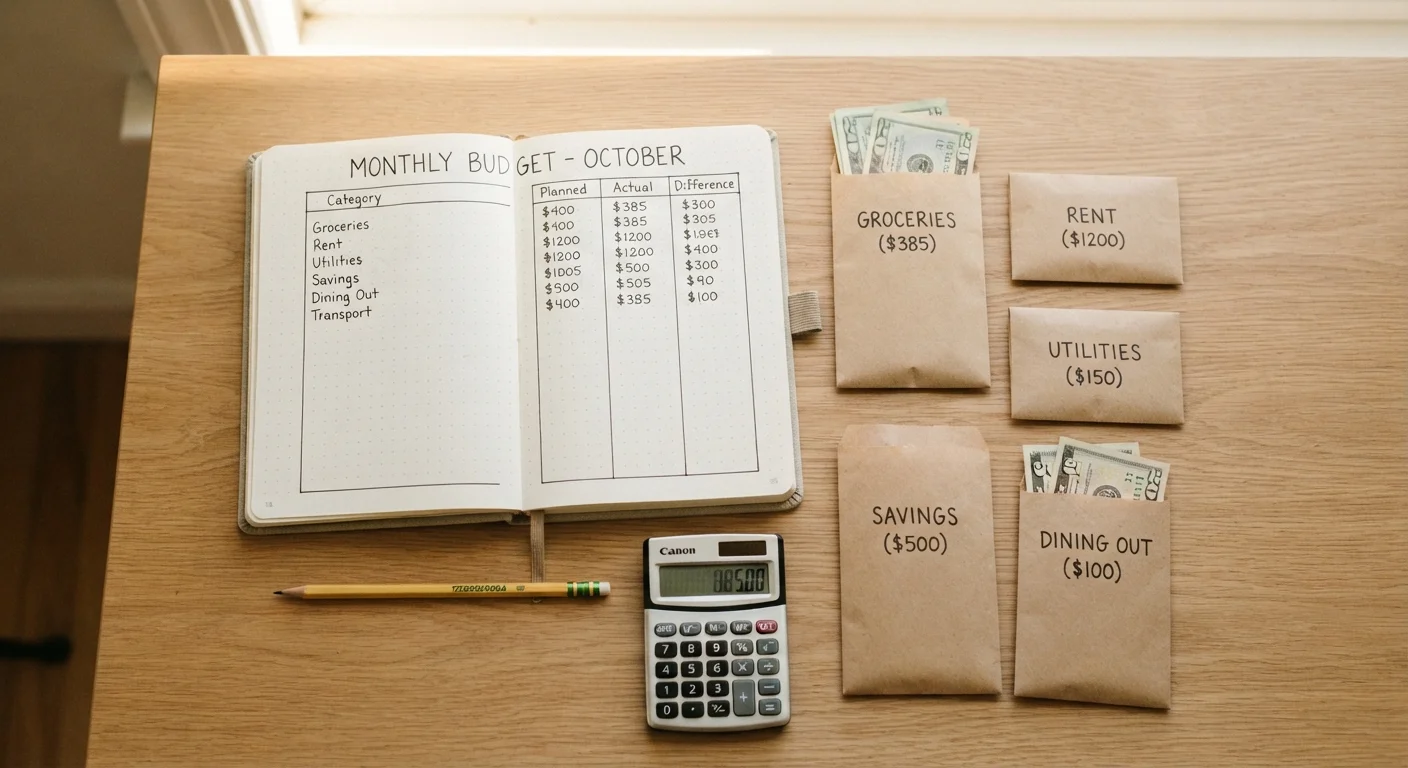
The envelope method divides your spending money into physical categories - literally using labeled paper envelopes. You withdraw cash at the start of the month, sort it into envelopes ("Groceries: $400," "Dining Out: $100," "Gas: $150"), and spend only from the relevant envelope. When an envelope runs out, spending in that category stops for the month.
The built-in friction of using cash is the method's main feature, not a bug. Research on consumer behaviour consistently suggests that people tend to spend more carefully with cash than with cards because the transaction feels more tangible. For a deeper look at how this compares to other cash-based approaches, see cash-based budgeting methods explained.
Many people now use a digital envelope variation - splitting funds across separate sub-accounts or using a budgeting app that mimics the envelope structure without requiring physical cash. This hybrid approach keeps the category-limit discipline while working within a modern, card-based lifestyle.
Digital Envelopes Are a Valid Option
If carrying cash feels impractical, several budgeting apps offer virtual envelope features that work with debit cards and bank accounts. The core principle - a hard cap per category - remains the same. Just be aware that swiping a card still tends to feel less 'real' than handing over cash, so check your category balances frequently to preserve the method's discipline.
How They Compare Head to Head
Both methods share a core philosophy: spend with intention, not habit. But they differ significantly in setup, maintenance, and day-to-day use. The table below highlights the key differences.
| Criterion | Zero-Based Budgeting | The Envelope Method |
|---|---|---|
| Core mechanic | Assign every dollar a job | Cap spending with cash envelopes |
| Setup time | 30-60 min per month | 15-30 min per pay cycle |
| Uses cash or cards? | Works with cards and apps | Traditionally cash-based |
| Spending limit enforcement | Self-enforced via tracking | Physical limit when envelope empties |
| Flexibility mid-month | Easy to reallocate categories | Requires moving physical cash |
| Best income type | Steady monthly income | Steady income; predictable expenses |
| Learning curve | Moderate - requires planning | Low - intuitive and tactile |
If you're deciding between frameworks - or curious how these compare to percentage-based approaches - the savings frameworks side by side article offers a useful broader view.
Choosing the Right Method for You
Neither method is objectively superior. Your best choice depends on three factors: how you naturally engage with money, how consistent your income is, and how much time you're willing to invest in tracking.
- Choose zero-based budgeting if you want granular control, prefer digital tools, and are comfortable revisiting a plan at the start of each month.
- Choose the envelope method if you struggle with overspending in specific categories, learn better by doing, or find abstract numbers hard to act on.
- Consider combining both - use ZBB's full-income allocation logic to plan your month, then use envelope-style caps for the categories where you tend to overspend.
Whatever you choose, the tracking tool matters too. See paper, spreadsheet, or app for a practical breakdown of your options. And if you haven't built a budget yet, the first budget in seven steps walkthrough is a straightforward place to start.
~1 in 3
U.S. adults without a monthly budget
Surveys from the National Foundation for Credit Counseling have consistently found that a significant share of American adults do not follow a formal budget each month.
18%
Average increase in savings rate reported by new budgeters
Research published in the Journal of Financial Counseling and Planning has found that structured budgeting interventions are associated with meaningful improvements in personal savings rates on average.
This article is for general informational and educational purposes only. It does not constitute personalised financial advice. Consider speaking with a qualified financial professional about your specific situation.