

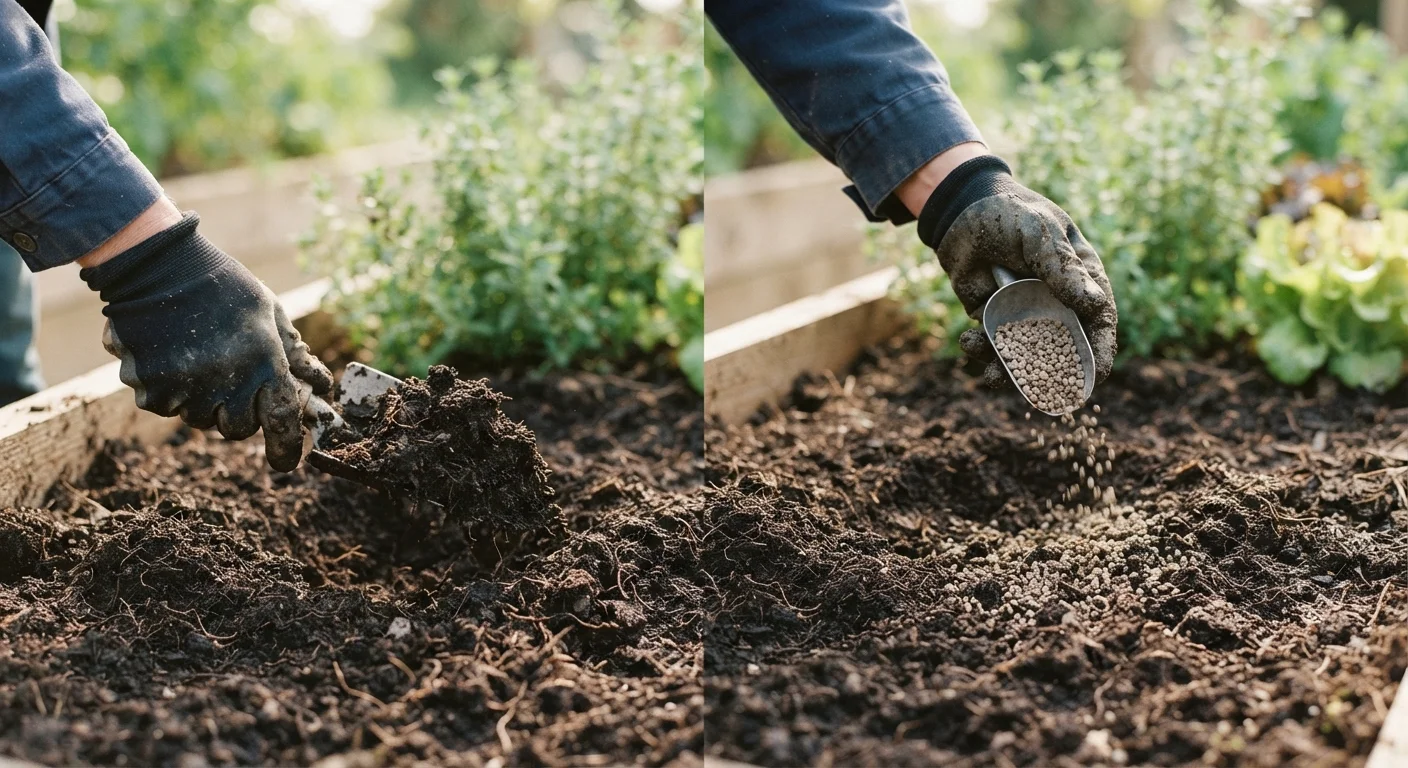
Key Takeaways
Option A
Compost
The long-game soil builder.
Best for: Gardeners who want to improve soil structure, water retention, and microbial life over time.
Option B
Fertiliser
The targeted nutrient boost.
Best for: Plants showing signs of nutrient deficiency or crops that need a quick feed during active growth.
If you're building a new garden bed from scratch
Compost
Compost improves the physical structure of the soil - its texture, drainage, and ability to hold moisture - before a single plant goes in. It creates the environment where roots thrive long-term.
If your plants look pale or have stunted growth mid-season
Fertiliser
When a plant is actively struggling with a nutrient gap, compost works too slowly to help. A targeted fertiliser can address the shortfall while the plant is still growing.
If you want a low-maintenance, hard-to-get-wrong approach
Compost
Compost is very difficult to over-apply and requires no measuring. It releases nutrients gradually, making it a forgiving choice for beginners.
If you're growing heavy-feeding vegetables like tomatoes or corn
Fertiliser
High-demand crops often need more nitrogen and potassium than compost alone provides during peak growing periods. A balanced fertiliser fills that gap reliably.
What Each One Actually Does
Gardening advice often treats compost and fertiliser as interchangeable, but they work in fundamentally different ways. Understanding the distinction saves you money and helps your plants more reliably.
Compost is decomposed organic matter - kitchen scraps, leaves, garden waste - broken down by microbes into a dark, crumbly material. When you dig it into soil or spread it on the surface, it does several things at once: it binds loose sandy soils so they hold water better, it opens up dense clay soils so roots and air can move through, and it feeds the community of bacteria and fungi that make nutrients available to plants. Think of compost as improving the environment your plants live in.
Fertiliser, by contrast, delivers specific nutrients directly - most commonly nitrogen (N), phosphorus (P), and potassium (K), often listed on packaging as an N-P-K ratio. These are the mineral building blocks plants need to grow leaves, develop roots, and produce fruit. Fertiliser does not meaningfully improve soil structure; it simply resupplies nutrients, either slowly via granules or quickly via liquid formulas.
If you're just getting started, see our beginner's guide to starting a garden for a wider look at what your plot needs before the first seed goes in.
| Criterion | Compost | Fertiliser |
|---|---|---|
| Primary purpose | Improves soil structure and biology | Supplies specific plant nutrients |
| Speed of effect | Slow - weeks to months | Fast - days to weeks |
| Risk of over-application | Very low | Moderate to high |
| Improves drainage and texture | Yes | No |
| Feeds soil microbes | Yes | Minimally or not at all |
| Can be homemade | Yes - kitchen and garden waste | Generally no |
| Precision required | Low - apply generously | High - measure carefully |
When to Use Compost, When to Use Fertiliser - and When to Use Both
The practical answer for most home gardeners is: start with compost, and add fertiliser only when there's a clear reason to.
Lean on compost when:
- You're preparing a new bed or planting area
- Your soil is very sandy, compacted, or drains poorly
- You want to maintain long-term soil health without regular intervention
- You're growing low-to-medium demand plants like herbs, leafy greens, or flowers
Bring in fertiliser when:
- Plants show yellowing leaves, slow growth, or poor fruiting mid-season
- You're growing heavy feeders - tomatoes, sweet corn, squash
- You're gardening in containers, where nutrients deplete faster
- A soil test reveals a specific deficiency
Using both together is common and effective: compost at planting time as a soil conditioner, and a light fertiliser application during peak growth if plants signal a need. What to avoid is substituting one for the other - applying only fertiliser to poor soil, for example, feeds the plant short-term while the underlying soil problems persist.
A Soil Test Can Guide Your Decision
If you're unsure whether your soil needs compost, fertiliser, or both, an inexpensive soil test can help. Basic test kits measure pH and key nutrient levels and are available at most garden centres. Results tell you whether your soil is already nutrient-rich (in which case fertiliser may be unnecessary) or structurally poor (where compost will make the biggest difference). Local cooperative extension services in the US often offer more detailed testing with tailored recommendations for your region.
For more on why your soil's physical properties matter just as much as its nutrient content, our article on what well-draining soil actually means covers the topic clearly.
Common Mistakes to Avoid
Even with good intentions, it's easy to misuse either input. Here's what to watch for:
With compost:
- Using it before it's fully decomposed. Immature compost can tie up nitrogen temporarily. Finished compost smells earthy, not rotten, and looks uniform in texture.
- Expecting fast results. Compost works over weeks and seasons. It's not a rescue remedy for a struggling plant today.
With fertiliser:
- Applying too much. Over-fertilising - especially with nitrogen - can burn roots, encourage leafy growth at the expense of fruit, and leach into waterways. Always follow the application rate on the packaging.
- Using it as a substitute for healthy soil. Fertiliser cannot fix compaction, poor drainage, or low microbial activity. These are structural problems that only compost and organic matter can address over time.
Many common gardening misconceptions touch on both inputs - our piece on widespread garden myths looks at the evidence behind advice you've probably heard before.
Before your next planting session, it's also worth running through our garden readiness checklist, which includes soil prep steps alongside spacing, light, and watering setup.
~5%
Organic matter in healthy garden soil
Soil scientists generally consider around 5% organic matter a marker of good soil health; many garden soils fall well below this without regular compost additions.
3-6 months
Typical time to produce finished compost
Under warm conditions with regular turning and the right mix of green and brown materials, a home compost pile can produce usable compost in roughly 3-6 months.