

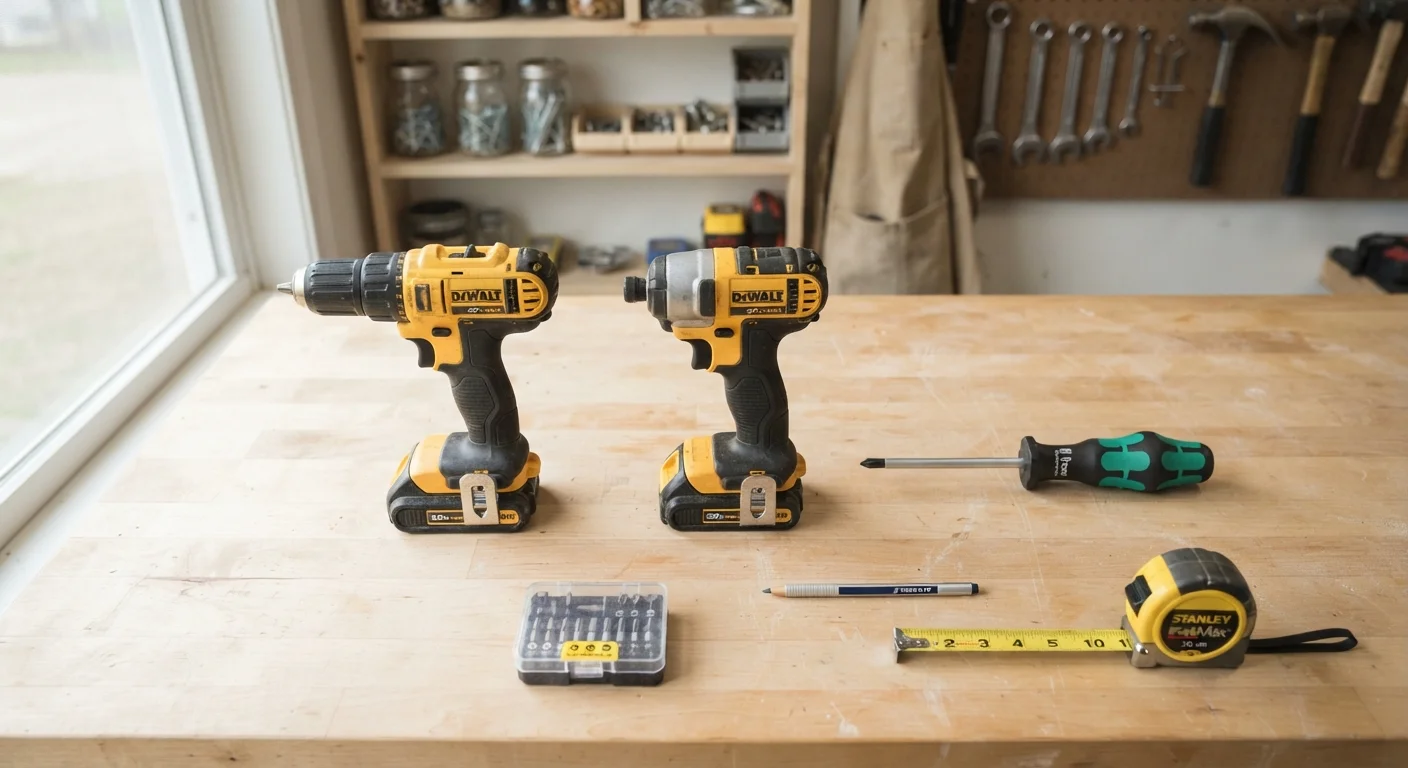
Key Takeaways
Our Verdict
Each of these three tools has a distinct job, and knowing which to grab makes your work faster and safer. For beginners tackling everyday household repairs, a cordless drill-driver covers the majority of tasks, while a manual screwdriver handles the fine, precise work that power tools can't do gently enough.
| Best for | Recommended |
|---|---|
| Boring holes in walls, wood, or plastic | Cordless Drill |
| Driving long screws or assembling flat-pack furniture | Impact Driver |
| Tightening small screws on electronics, hinges, or switches | Manual Screwdriver |
| All-around beginner home repairs on a minimal tool budget | Cordless Drill (with driver bits) |
What Each Tool Is Actually Built to Do
Walk into any hardware store and the sheer variety of power tools can feel overwhelming. For most household repairs, though, you only need to understand three tools: the cordless drill, the impact driver, and the manual screwdriver. They look similar, but each is engineered around a different job.
Cordless drill: The rotating chuck - the clamp-like collar at the front - is designed to spin a drill bit, creating a hole in wood, drywall, plastic, or masonry (with the right bit). Most modern cordless drills double as drill-drivers, meaning they can also drive screws using a clutch that limits torque. This makes them the most versatile all-rounder for beginners.
Impact driver: Smaller and lighter than a drill, an impact driver adds a hammering rotational force (called impact action) that kicks in automatically when resistance is high. This mechanism is what makes it excellent at driving long screws or lag bolts without stripping them - tasks that would stall or strain a standard drill.
Manual screwdriver: No battery, no noise, no torque setting required. A manual screwdriver gives you complete hand-controlled precision. It's the right tool whenever a power driver risks over-tightening - think cabinet hinges, electrical outlet covers, or small appliance screws.
Side-by-Side: How They Compare on What Matters
To make the right call, it helps to see how these tools stack up across the factors that matter most for everyday repairs.
| Cordless Drill | Impact Driver | Manual Screwdriver | |
|---|---|---|---|
| Primary job | Boring holes | Driving fasteners under load | Precise fastener tightening |
| Ease of use for beginners | Moderate - learn clutch settings | Easy once you know the limits | Very easy, intuitive |
| Risk of stripping screws | Moderate if clutch is too high | Higher on short or soft screws | Very low with correct hand pressure |
| Noise and vibration | Moderate | High - loud impact action | None |
| Battery required | Yes | Yes | No |
| Best material | Wood, drywall, plastic | Hardwood, timber, metal bolts | Any - especially soft or delicate |
| Portability | Good | Excellent - compact and light | Perfect - fits in a pocket |
Notice that no single tool wins across every category. That's the point - they're genuinely complementary, not interchangeable.
Practical Scenarios: Which Tool to Pick
Here's how to apply this in real situations around the home:
- Hanging a shelf on a stud wall: Use your drill to bore a pilot hole first (this prevents wood from splitting), then switch to a driver bit to drive the screw in. Before you drill, check out our guide to locating wall studs - hitting a stud is essential for a secure anchor.
- Building flat-pack furniture: An impact driver makes quick work of the many screws involved, and its compact size is an advantage in tight corners. A drill-driver on a low clutch setting also works well here.
- Replacing a light switch cover: Reach for the manual screwdriver every time. Power tools on small screws in plastic housings will strip the head before you realize what's happened.
- Drilling into tile or masonry: You need a drill with a hammer function (sometimes called a hammer drill) and a masonry bit. A standard drill-driver or impact driver is not designed for this task.
- Tightening loose cabinet hinges: Manual screwdriver only. The screws are short and the wood is often pre-existing; a power tool will blow right past the correct torque.
Start With a Drill-Driver Combo
If you're building your first toolkit, a cordless drill-driver covers the widest range of household tasks in a single tool. Pair it with a basic set of drill bits and driver bits, and add a manual screwdriver for small, precise work. You'll handle the vast majority of home repairs without needing anything else right away.
Common Mistakes - and How to Avoid Them
Most beginner frustrations with these tools come down to a handful of repeatable errors:
- Skipping a pilot hole: Driving a screw directly into wood - especially near an edge - often causes splitting. Drill a pilot hole slightly narrower than the screw shaft first.
- Wrong clutch setting on a drill-driver: The numbered ring around the chuck controls torque. Start at a low number and increase gradually; too high and you'll overtighten or strip the screw head.
- Using an impact driver on soft materials: The impact mechanism is powerful. On soft pine or thin MDF, it can drive screws too deep, tearing up the surface.
- Mismatched bit and screw: A Phillips bit in a Pozidriv screw (they look similar but aren't identical) will cam out and strip the head. Check your screw type and match the bit accordingly.
Building good habits from the start makes a real difference. If you're new to DIY generally, you might find it helpful to run through a beginner's checklist before tackling your first project - setting yourself up properly saves time and frustration.
Never Use Power Tools Near Electrical Wiring
Before drilling into any wall, ceiling, or floor, confirm there are no live electrical cables, water pipes, or gas lines running behind the surface. Accidental contact with wiring or pipework can cause serious injury or structural damage. Use a cable detector (available at most hardware stores) and, when in doubt, consult a licensed electrician or plumber before proceeding.