

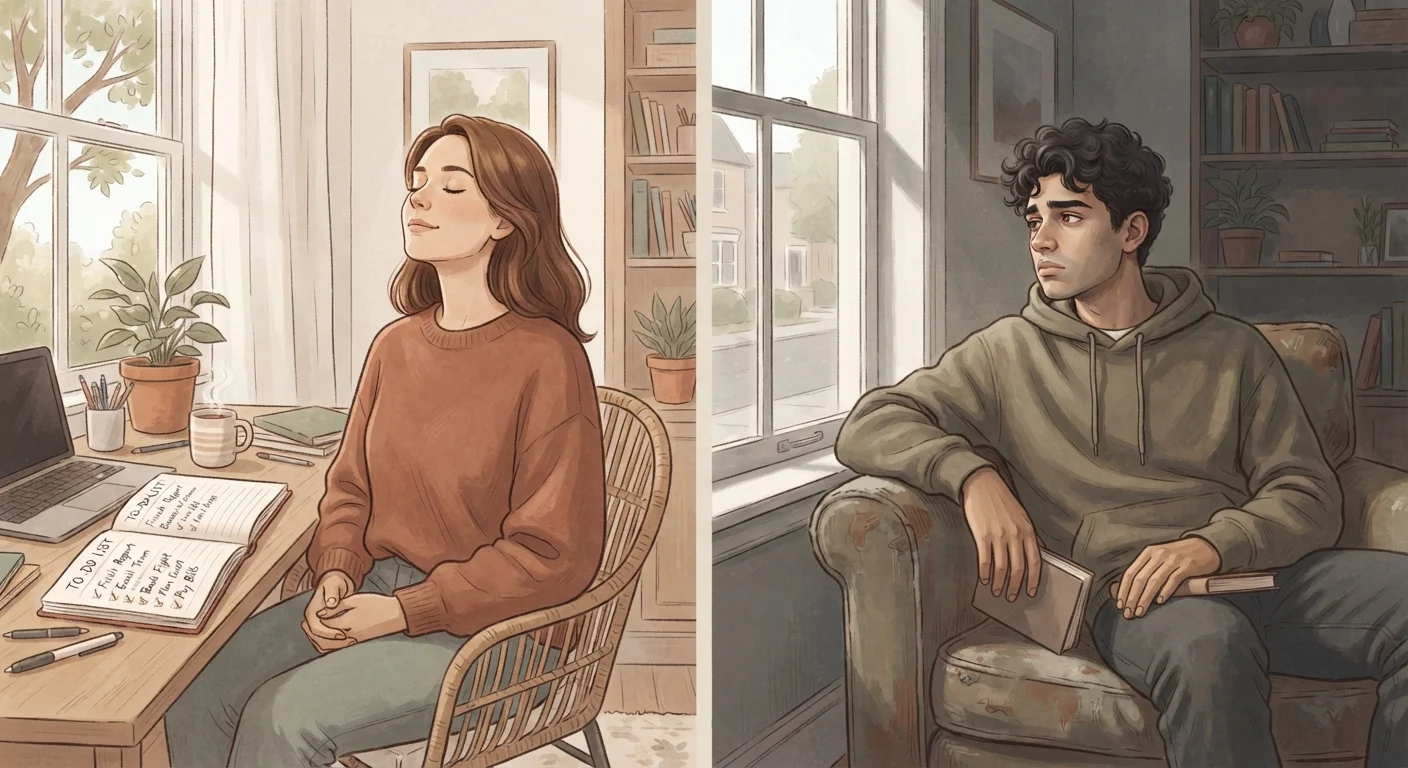
Key Takeaways
Option A
Everyday Stress
A normal, temporary response to real-world pressure.
Best for: Understanding when your body is reacting appropriately to a specific challenge or deadline.
Option B
Anxiety
A persistent state of worry that outlasts its trigger.
Best for: Recognizing when worry feels disproportionate or uncontrollable, and knowing when to seek support.
If you feel wound up before a deadline but return to normal afterward
Everyday Stress
This is a textbook stress response - situational, proportionate, and self-resolving once the pressure lifts.
If worry feels constant and hard to switch off even when things are calm
Anxiety
Persistent, free-floating worry without a clear cause is more characteristic of anxiety and may benefit from professional support.
If physical symptoms like tension or poor sleep keep recurring
Anxiety
Ongoing physical symptoms tied to worry - especially without a specific stressor - can signal anxiety rather than ordinary stress.
If you want to build general resilience and coping skills
Everyday Stress
Learning to manage typical stress well creates healthy habits that also reduce anxiety's foothold over time.
Why the Distinction Matters
Most of us use "stress" and "anxiety" interchangeably, and that's understandable - they can feel remarkably similar in the moment. Your heart beats faster, your thoughts race, and your body feels on edge. But these two experiences have different origins, different durations, and - crucially - different approaches that tend to help most.
Knowing which one you're dealing with isn't about labeling yourself. It's about responding in the most useful way. Treating anxiety purely as stress you need to push through, or dismissing stress as a disorder, can leave you spinning your wheels. Understanding how your stress response works is a useful first step before distinguishing the two.
| Criterion | Everyday Stress | Anxiety |
|---|---|---|
| Primary cause | Identifiable external stressor | Often unclear or disproportionate trigger |
| Duration | Fades when stressor resolves | Persists beyond the triggering event |
| Focus of worry | Present-tense challenge | Future-focused "what if" thinking |
| Physical symptoms | Tension, fatigue, restlessness | Similar, often more intense or frequent |
| Sense of control | Generally feels manageable | Worry can feel hard to switch off |
| Impact on daily life | Temporary disruption | May interfere with routines and relationships |
Everyday Stress: Wired for Challenge
Stress is your body's built-in reaction to a real, identifiable demand - a work presentation, a difficult conversation, a tight budget, or a health scare. The American Psychological Association describes stress as a response to an external cause, and it generally fades once that cause is resolved or removed.
That's actually stress working correctly. In manageable doses, stress sharpens focus and motivates action. The problem arises when stressors pile up without relief. Chronic, ongoing stress can spill into the body in ways that feel significant - disrupted sleep, muscle tension, and digestive upset among them. What stress actually does to your body goes deeper on those physical effects.
77%
Adults reporting physical stress symptoms
According to American Psychological Association surveys, a large majority of US adults regularly experience physical symptoms they attribute to stress.
31%
US adults affected by anxiety disorder
The National Institute of Mental Health estimates that roughly one in three US adults will experience an anxiety disorder at some point in their lifetime.
Anxiety: When Worry Outlasts Its Trigger
Anxiety shares many of stress's physical hallmarks, but it behaves differently at the source. Rather than being tied to a specific, present-tense challenge, anxiety tends to persist or intensify even when no clear threat exists. It's often forward-looking - a sense of dread about what might happen - and the worry can feel disproportionate to the actual situation.
Some anxiety is a normal part of life. It's only when anxiety becomes persistent, difficult to control, or begins interfering with daily routines that it crosses into territory worth taking seriously. Anxiety disorders are among the most common mental health conditions in the United States, according to the National Institute of Mental Health, affecting a significant portion of adults at some point in their lives.
It's also worth noting that stress and anxiety often co-exist and feed each other - much the way sleep and stress interact. Explore how sleep and stress affect one another to see how these cycles reinforce themselves.
A Note on Professional Support
If you find yourself regularly struggling to identify whether what you feel is stress or anxiety, that uncertainty itself is worth discussing with a professional. A licensed therapist or counselor - particularly one trained in cognitive behavioral approaches - can help you understand your patterns and develop strategies tailored to your specific experience. You don't need to be in crisis to reach out.
How to Respond to Each
For everyday stress, practical coping tools tend to work well: time management, physical movement, brief breathing exercises, and setting realistic expectations. The goal is to reduce or remove the stressor where possible, and to recover effectively in between pressures.
For anxiety, those same tools can help, but they often work better as part of a broader, consistent practice. Techniques like cognitive reframing (noticing and gently questioning worried thoughts), mindfulness and meditation, and grounding exercises are commonly recommended. If anxiety feels persistent, uncontrollable, or is limiting your daily life, connecting with a mental health professional is a genuinely important step - not a last resort.
If you're exploring digital tools to supplement your approach, it's worth pausing to think through what you actually need. Before you try a stress-relief app, consider what features would actually serve your situation.
This article is for general informational purposes only and is not a substitute for professional medical or mental health advice. If you are experiencing symptoms that concern you, please consult a qualified healthcare provider.