

Key Takeaways
Option A
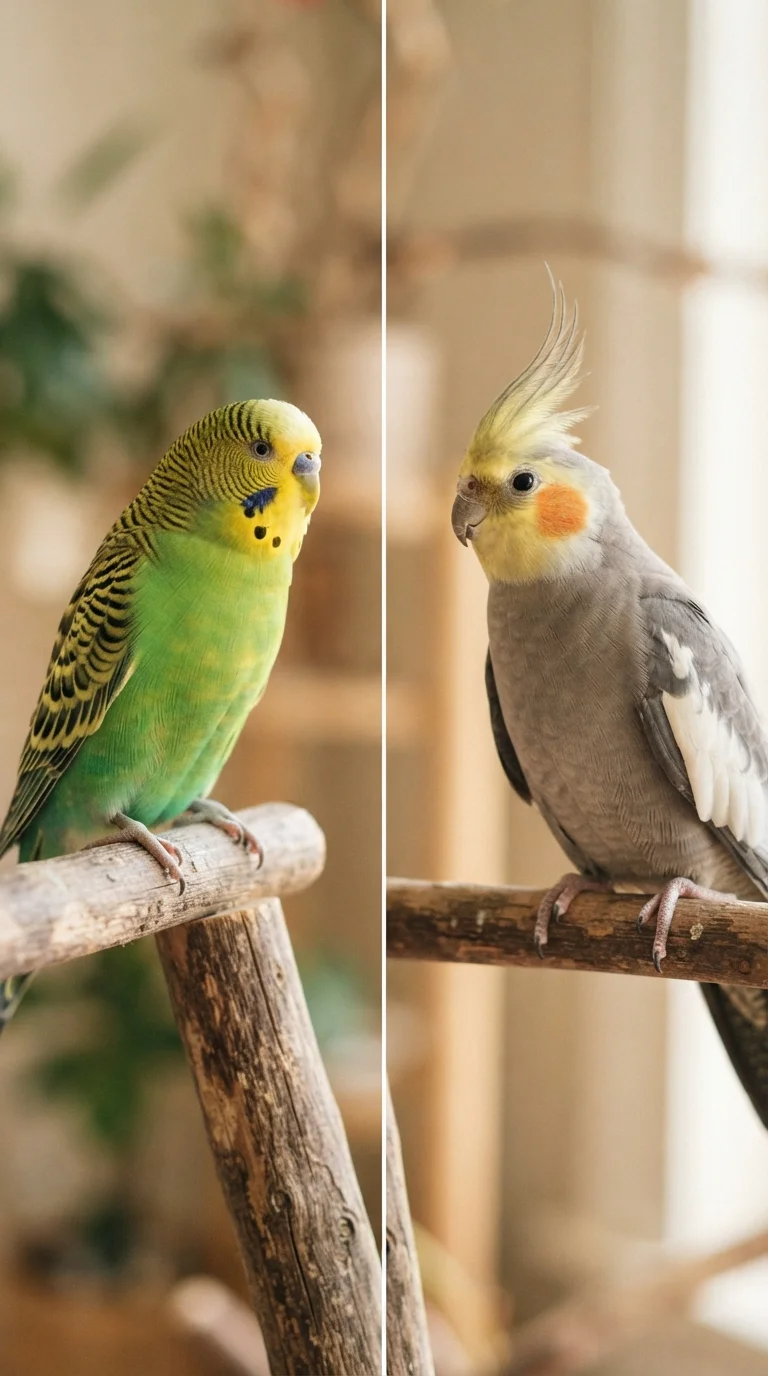
Budgerigar (Budgie)
The compact, chatty, and endlessly charming starter bird.
Best for: Apartment dwellers or first-time bird owners who want an interactive, lower-maintenance companion in a small footprint.
Option B
Cockatiel
The affectionate, melody-loving bird with a big personality.
Best for: Owners who have a little more space and time to offer daily hands-on bonding with a gentle, expressive companion.
If you live in an apartment or smaller space
Budgerigar (Budgie)
Budgies need a smaller cage footprint and produce less noise, making them better suited to close-quarter living without disturbing neighbors.
If you want a cuddly, hands-on companion
Cockatiel
Cockatiels are naturally inclined toward physical affection - many will happily perch on a shoulder or lean into a head scratch for extended periods.
If you're a first-time bird owner
Budgerigar (Budgie)
Budgies are forgiving of beginner mistakes, relatively low-cost to keep, and adapt well to gentle handling and gradual taming.
If you enjoy teaching your bird to whistle or sing
Cockatiel
Cockatiels are natural whistlers and can learn short melodies with patient, consistent training - a rewarding experience for musically inclined owners.
If you're looking for a long-term companion commitment
Cockatiel
With a lifespan often reaching 15-20 years in good conditions, a cockatiel represents a deeper, decades-long bond for committed owners.
Size, Space, and Cage Requirements
One of the first practical questions any prospective bird owner faces is: how much space do I actually need? Here, the two species diverge clearly.
Budgerigars typically measure around 7 inches from beak to tail and weigh roughly 1-1.4 ounces. A single budgie can thrive in a cage sized approximately 18×18×24 inches, though bigger is always better. Their compact size makes them genuinely apartment-friendly.
Cockatiels are noticeably larger - around 12-13 inches long and 3-4 ounces - and need a cage of at least 24×24×30 inches to move comfortably. They also benefit from wider bar spacing to accommodate their broader wingspan during climbing and stretching.
Both species need daily out-of-cage time in a bird-proofed room. Cockatiels tend to use that space more actively, so owners should ensure open-window hazards, ceiling fans, and non-stick cookware fumes are eliminated before giving either bird free-flight time.
| Criterion | Budgerigar | Cockatiel |
|---|---|---|
| Average size | ~7 inches, ~1 oz | ~12-13 inches, ~3-4 oz |
| Minimum cage size | 18×18×24 inches | 24×24×30 inches |
| Average lifespan | 7-12 years | 15-20 years |
| Noise level | Soft chatter, low volume | Whistles, moderate volume |
| Affection style | Independent, finger-perching | Cuddly, seeks close contact |
| Talking ability | Can mimic words clearly | Whistles tunes; some words |
| Beginner-friendliness | Very high | High |
| Daily time commitment | Moderate | Moderate to high |
Temperament and Handling
Temperament is often the deciding factor for new owners, and the two birds have genuinely different social styles.
Budgies are social and curious but can take time to warm up to handling. Once tamed - a process that rewards patience and consistency - they enjoy perching on fingers and exploring their environment. They tend to be more independent than cockatiels and can entertain themselves well when provided with toys and a bird companion.
Cockatiels are often described as "velcro birds" - they actively seek out human company and physical closeness. Many cockatiels will request head scratches by lowering their head toward a hand, and they respond visibly to mood changes in their household. This emotional sensitivity means they can become stressed if regularly left alone for long hours.
If you work from home or have family members around during the day, a cockatiel's social needs are easier to meet. For busier households, keeping two budgies together can provide mutual companionship without over-relying on human interaction.
7-12 yrs
Average budgerigar lifespan with good care
Budgies are short-to-medium-commitment pets compared to many other parrot-family species.
15-20 yrs
Typical cockatiel lifespan in healthy conditions
A cockatiel adopted today may still be with you two decades from now - a meaningful long-term decision.
Top 3
Cockatiels rank among the world's most kept pet birds
Alongside budgerigars, cockatiels consistently appear among the most popular companion birds globally, according to avian welfare organizations.
Noise Levels and Vocalization
Neither budgies nor cockatiels are silent birds, but the type and volume of their sounds differ meaningfully.
Budgies produce a cheerful, continuous chatter - a soft stream of chirps, whistles, and mimicked syllables. They can learn to say words, and some develop surprisingly clear vocabularies with consistent training. Their volume is generally low enough that neighbors in an adjacent apartment rarely notice.
Cockatiels are whistlers by nature. Males in particular will repeat short songs throughout the day, and contact calls - used when a bird wants to locate its flock - can be quite piercing. A cockatiel calling for attention from another room carries noticeably further than a budgie's chatter. That said, cockatiels are rarely as loud as larger parrots such as African greys or macaws.
If noise sensitivity is a concern in your living situation, a budgie's softer vocalization profile is the safer choice. If you enjoy lively, melodic sounds and can accommodate occasional louder calls, a cockatiel's musical personality is part of its considerable charm.
Diet, Health, and Lifespan
Both species thrive on a varied diet built around a high-quality pelleted base supplemented with fresh vegetables, leafy greens, and limited fruit. Seeds alone - though popular as treats - are high in fat and nutritionally incomplete as a primary diet for either bird. Fresh water should always be available.
Budgies have an average lifespan of 7-12 years with good care, though some reach 15 years. Common health concerns include tumors, iodine deficiency (linked to all-seed diets), and respiratory illness. Regular avian veterinarian check-ups are important, as budgies often mask illness until it is advanced.
Cockatiels typically live 15-20 years in good conditions, representing a longer commitment. They are susceptible to respiratory infections, nutritional deficiencies, and a condition called Psittacosis (a bacterial infection transmissible to humans in rare cases) - which underscores the importance of sourcing birds from reputable, health-checked environments and scheduling routine vet visits.
Both species need an avian-specialist vet rather than a general small-animal practice, so locating one in your area before bringing a bird home is a sensible first step.
Finding an Avian Veterinarian
Not all veterinary practices are equipped to treat birds. Before bringing either species home, search for a vet certified or experienced in avian medicine - the Association of Avian Veterinarians (AAV) maintains a directory that can help you locate a qualified practitioner in your area. A baseline health check shortly after adoption is strongly recommended for any new bird, regardless of where it was sourced.