

Key Takeaways
Option A
Debt Avalanche
The mathematically efficient, interest-saving approach.
Best for: People who are motivated by numbers and want to minimize total interest paid over time.
Option B
Debt Snowball
The psychologically rewarding, momentum-building approach.
Best for: People who need early wins to stay motivated and build confidence with debt repayment.
If you want to pay the least total interest possible
Debt Avalanche
By targeting the highest-interest debt first, the avalanche method reduces the amount that compounds against you, saving money over the full repayment timeline.
If you struggle to stay motivated and need early momentum
Debt Snowball
Knocking out smaller balances quickly creates visible progress and a psychological boost that can make it easier to stay committed to your plan.
If your debts are all similar in balance and interest rate
Debt Avalanche
When debts are comparable, the avalanche's cost savings tip the scales without sacrificing much motivational difference.
If you've tried debt repayment before and quit
Debt Snowball
A history of stopping suggests motivation is the real barrier. The snowball's quick wins address exactly that - keeping you in the game long enough to succeed.
The Core Idea Behind Each Method
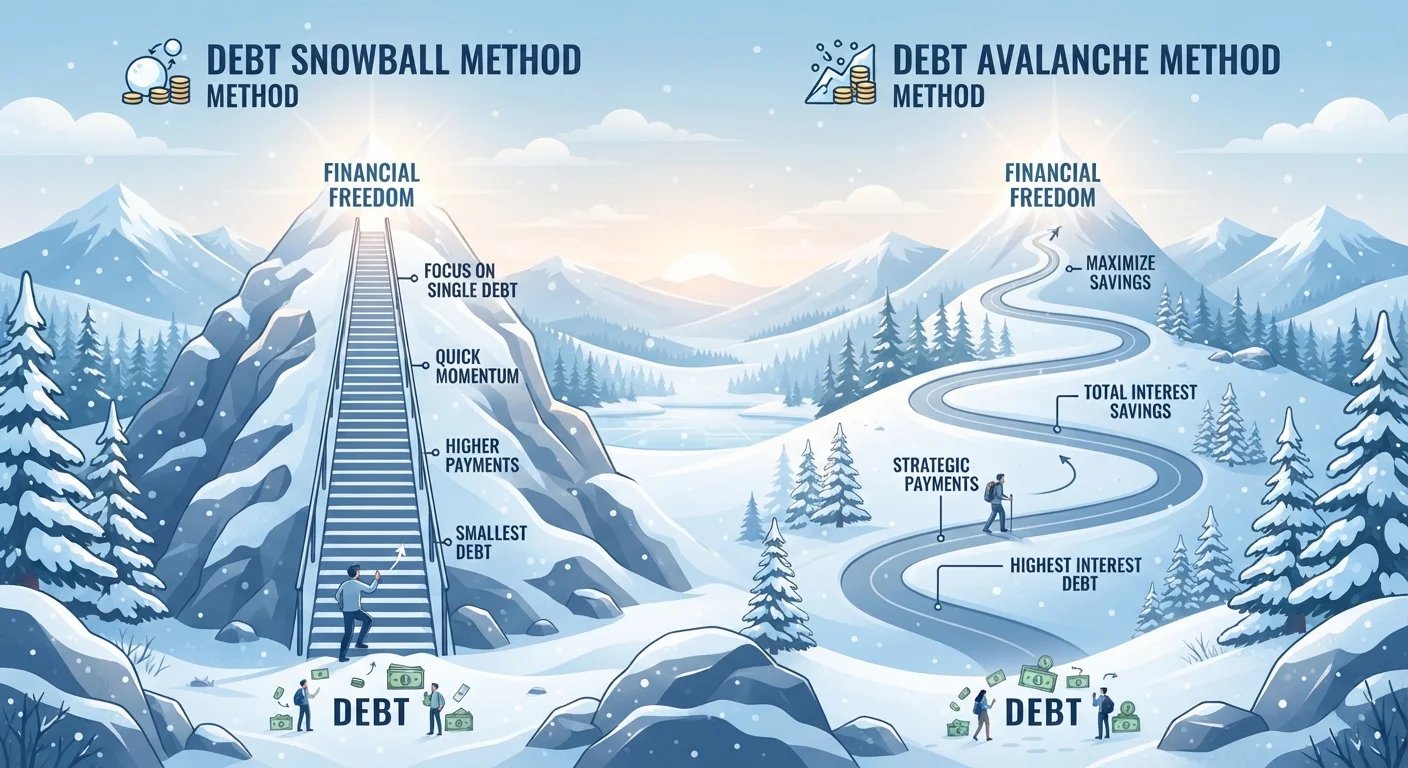
Both the debt avalanche and debt snowball follow the same basic framework: list all your debts, make the minimum payment on every one each month, and then direct any extra money toward a single target debt. The difference is which debt you target first.
With the avalanche method, you rank your debts from the highest interest rate (APR) to the lowest. You attack the highest-rate debt with all your extra funds until it's gone, then move to the next. Because high-interest debt grows fastest, eliminating it first limits what you pay overall.
With the snowball method, you rank your debts by balance - smallest to largest - and pay off the smallest one first regardless of its interest rate. Once it's cleared, you roll that freed-up payment into the next smallest balance, building momentum like a snowball rolling downhill.
If you're just starting out, this beginner's guide to facing debt can help you get your full picture before choosing a method.
How They Compare Side by Side
Choosing between these two methods becomes clearer when you look at the key dimensions directly.
| Criterion | Debt Avalanche | Debt Snowball |
|---|---|---|
| Payoff order | Highest interest rate first | Smallest balance first |
| Total interest paid | Lower (mathematically optimal) | Potentially higher |
| Time to first paid-off account | Can take longer | Often faster |
| Psychological reward | Delayed - based on savings | Early - based on quick wins |
| Best suited for | Numbers-driven, patient savers | Motivation-driven beginners |
| Complexity | Requires tracking APRs | Simple - just sort by balance |
One important nuance: the avalanche almost always wins on total cost, but the margin depends on your specific debts. If your highest-interest balance also happens to be your largest, the avalanche can feel slow for a long time before you see a payoff - which is exactly where motivation tends to collapse.
The Psychology Factor
Research in behavioral economics suggests that people are more motivated by completing tasks than by abstract long-term savings. This is sometimes called the "goal gradient effect" - progress that feels visible accelerates commitment. That's the snowball's real advantage: it's engineered to feel effective quickly, even if the math isn't perfectly optimal.
~33%
U.S. adults carrying credit card debt month to month
Federal Reserve data consistently shows roughly one-third of U.S. adults carry revolving credit card balances, making a structured payoff strategy especially valuable.
2x
Likelihood of success with a written plan
Research on goal-setting generally finds that written, specific plans significantly increase follow-through compared to vague intentions, supporting the value of any structured method.
The avalanche asks you to trust the process longer before a balance hits zero. For some people, that's fine - especially if they track interest saved rather than accounts closed. For others, months of payments with no celebration can quietly kill the habit.
Understanding which camp you fall into is genuinely useful data. Practical habits that keep repayment plans on track can help you build the structure that supports whichever method you choose.
A Practical Example
Say you have three debts:
- Credit card A: $800 balance, 24% APR
- Medical bill: $600 balance, 0% APR
- Personal loan: $3,200 balance, 11% APR
Avalanche order: Credit card A (24%) → Personal loan (11%) → Medical bill (0%). You'd save the most in interest this way, but the medical bill - despite being the second-smallest balance - waits until last.
Snowball order: Medical bill ($600) → Credit card A ($800) → Personal loan ($3,200). You'd clear two debts relatively quickly, even though the medical bill carries no interest and the credit card charges the most.
Neither order is wrong. The avalanche saves money; the snowball saves motivation. Building a realistic debt repayment plan from scratch walks through how to map this out with your actual numbers.
This article is for general informational purposes only and does not constitute personalized financial advice. Consult a qualified financial professional for guidance specific to your situation.