

Key Takeaways
Our Verdict
Neither online nor in-person learning is objectively better - each format plays to different strengths. Online learning suits self-motivated individuals with unpredictable schedules, while in-person classes tend to serve beginners who benefit from structure, immediate feedback, and human connection. Matching the format to your specific goals and habits matters more than picking one as a rule.
| Best for | Recommended |
|---|---|
| Self-motivated learners with busy or irregular schedules | Online Learning |
| Beginners who need structure, accountability, and hands-on feedback | In-Person Classes |
| Those looking to minimize upfront financial commitment | Online Learning |
| Learners focused on collaborative skills or practical techniques | In-Person Classes |
The Core Difference: Format Shapes the Experience
When you're starting a new skill, the question of where and how you learn can be just as important as what you're learning. Online learning and in-person classes don't just differ in location - they create fundamentally different rhythms, feedback loops, and social environments.
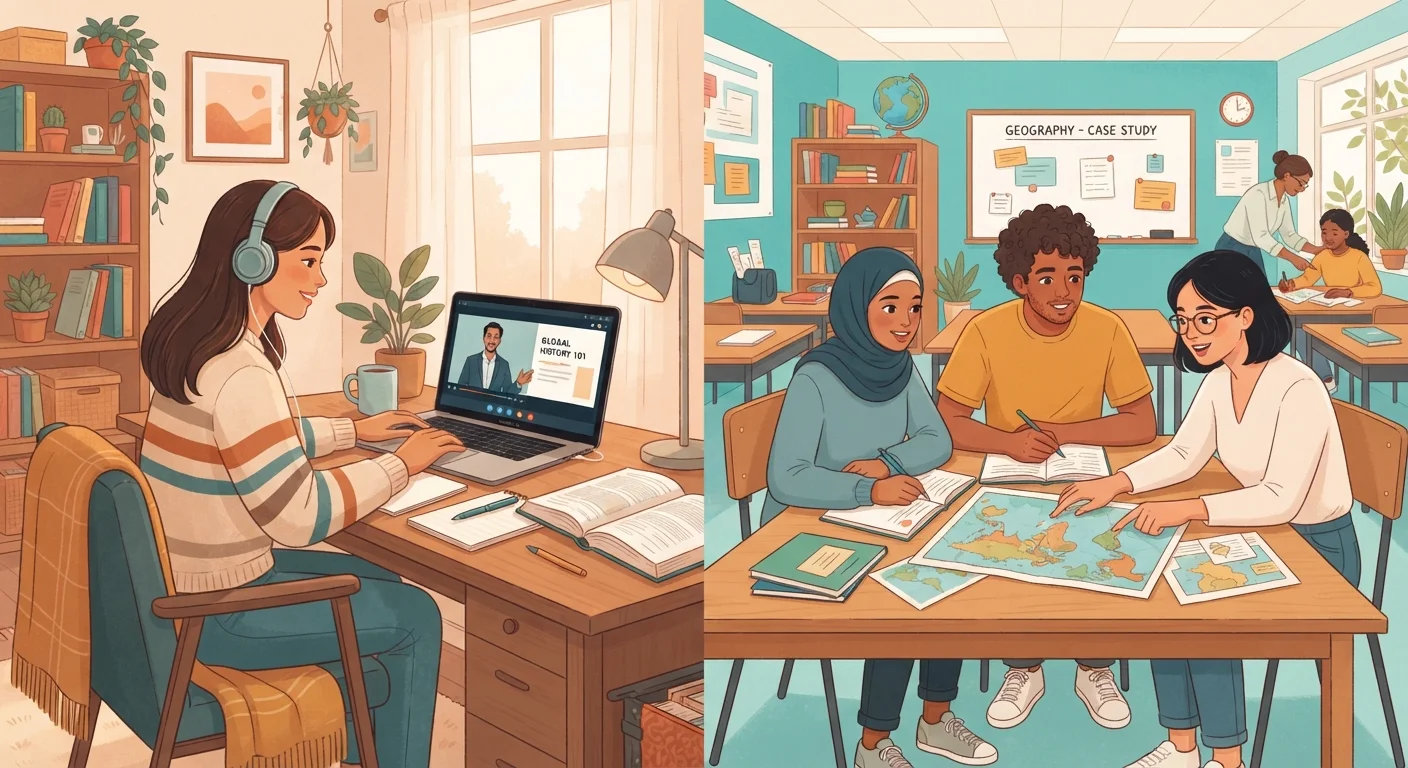
Online courses let you set your own pace, access materials on your schedule, and learn from instructors anywhere in the world. In-person classes put you in a shared physical space with a teacher and peers, creating real-time interaction and a built-in routine.
Neither format automatically produces better results. Research in education broadly suggests that outcomes depend heavily on learner behavior and engagement, not the delivery medium alone. What shifts between formats is the kind of support each one provides - and what it demands of you in return. For a deeper look at how your scheduling habits affect skill-building, see this guide on fixed versus flexible routines.
| Online Learning | In-Person Classes | |
|---|---|---|
| Scheduling Flexibility | High - learn on your own schedule | Low to moderate - fixed class times |
| Instructor Feedback | Delayed or limited (forums, email) | Immediate and in-person |
| Accountability | Self-managed; higher dropout risk | Built-in via attendance and peers |
| Typical Cost | Often lower; wide range available | Typically higher; room, staffing costs |
| Social Connection | Limited; requires deliberate effort | Natural; shared physical space |
| Best Skill Types | Technical, conceptual, self-paced | Hands-on, performance, collaborative |
Where Online Learning Has the Edge
Flexibility is online learning's most obvious advantage. You can fit lessons around work, family, and other commitments - pausing, rewinding, or revisiting content as often as needed. For topics like coding, graphic design, writing, or languages, the breadth of available courses is enormous, often at a fraction of the cost of classroom instruction.
Online formats also reduce logistical friction. No commute, no fixed class time, and no need to keep pace with a group. For learners who already have some self-discipline or who are returning to education after a break, this can feel liberating rather than isolating.
Set a Non-Negotiable Study Window
If you choose online learning, treat your study time like a class you've already paid for - block it in your calendar and protect it. Research on habit formation suggests that consistent timing strengthens the behavior over time. Even a 30-minute daily block is more effective than sporadic longer sessions.
That said, the flexibility that makes online learning appealing is also its biggest risk for beginners. Without external deadlines and peer accountability, many learners stall or drop out. Studies on Massive Open Online Courses (MOOCs) consistently show high enrollment but low completion rates - a pattern worth taking seriously before you commit. If you're weighing whether to go fully independent, the trade-offs of self-teaching covers similar terrain in more depth.
Where In-Person Classes Hold Their Own
Structured classes do something online formats struggle to replicate: they create consistent, low-friction accountability. Showing up at the same time each week - knowing a teacher and classmates expect you - is a powerful behavioral anchor, especially when motivation dips.
Immediate, in-the-moment feedback is another genuine advantage. An instructor can correct your posture in a yoga class, your grip in a pottery session, or your pronunciation in a language lesson in ways that asynchronous video simply cannot. For hands-on or performance-based skills, this matters enormously.
In-person settings also tend to foster incidental learning - the questions other students ask, the side conversations that clarify confusion, the shared struggle that builds confidence. Social learning is real, and it's often undervalued when people compare formats on paper. To progress more efficiently in either format, evidence-informed learning principles can sharpen your approach without sacrificing depth.
Don't Overlook Hidden Time Costs
In-person classes come with real time overhead beyond the lesson itself: commute, parking, and scheduling around fixed start times. Before signing up, map out the full time commitment, not just the class hours. If the logistics feel burdensome from the start, motivation is likely to erode faster than the skill builds.
How to Decide: Questions Worth Asking Yourself
Rather than defaulting to whichever format is trendier or cheaper, use these questions to clarify what you actually need:
- How self-directed are you? If you tend to procrastinate without external structure, in-person classes may serve you better to start.
- What skill are you building? Technical and conceptual skills often transfer well online; physical, interpersonal, or lab-based skills typically benefit from in-person instruction.
- What's your schedule really like? Honest assessment matters - a class you can't reliably attend teaches you nothing.
- Do you learn better alone or alongside others? Neither preference is wrong, but they point toward different formats.
Many learners find the most durable approach is a combination: using online resources for foundational knowledge and in-person sessions for practice, feedback, or community. The format is a tool - the goal is learning that actually sticks.
~15%
Average MOOC completion rate
Research across multiple MOOC platforms consistently finds that fewer than 15% of enrolled learners finish a course, highlighting the accountability gap in self-paced online formats.
70%+
Adults citing flexibility as top reason for online learning
Surveys by education researchers and institutions such as the Babson Survey Research Group have repeatedly identified scheduling flexibility as the primary driver of online course enrollment among adult learners.