

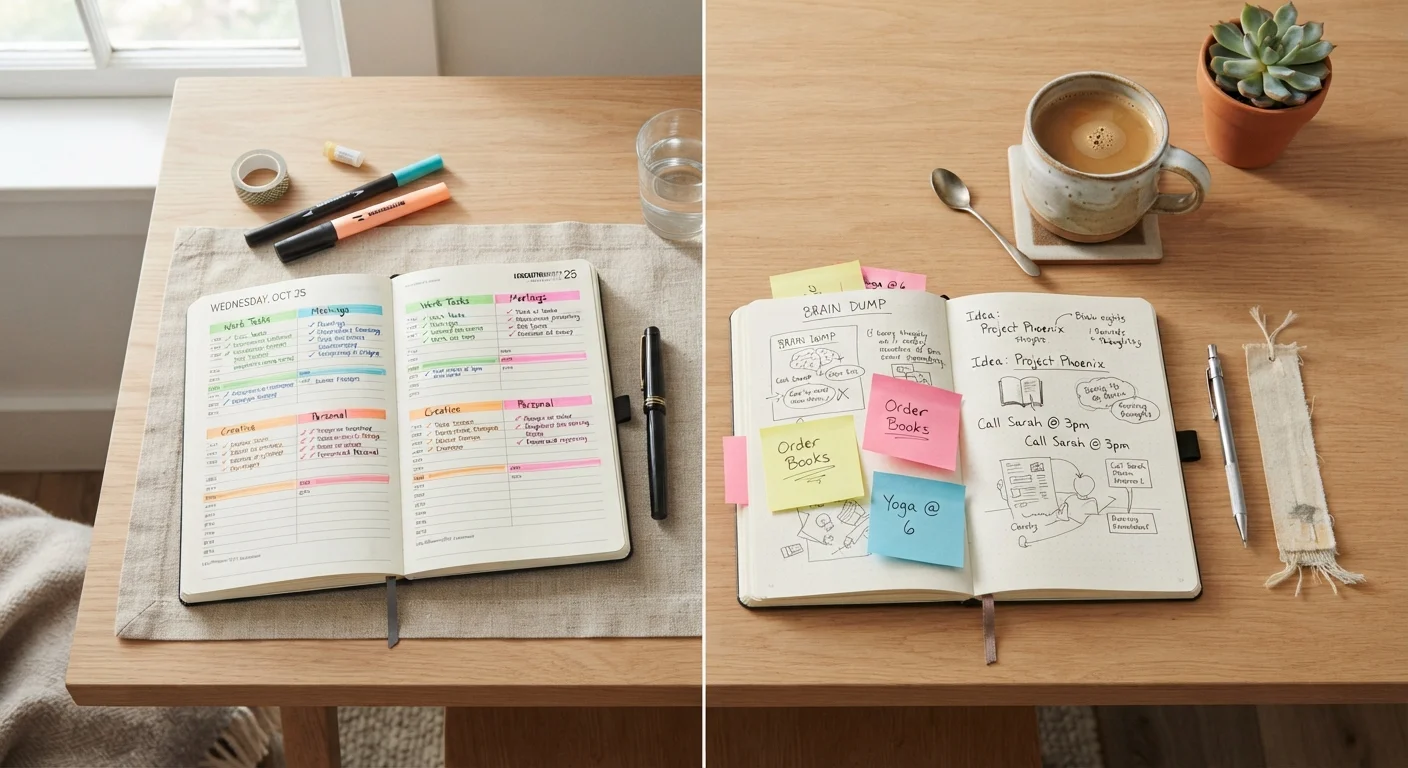
Key Takeaways
Eliminates daily decisions about when to act
Pre-assigned time slots mean you spend no mental energy deciding when to start a habit - the schedule does it for you, preserving willpower for the task itself.
Builds automatic behavior through time cues
Repeating a behavior at the same time each day creates a strong contextual cue, helping the brain recognize the moment as a trigger and making the habit feel increasingly effortless.
Makes progress easy to track and measure
When habits are scheduled, it's straightforward to record completion or identify exactly where consistency is breaking down - useful for troubleshooting and staying accountable.
Reduces reliance on motivation
Strict schedules work even on low-motivation days because the behavior is treated as non-negotiable, similar to a work meeting - not something you decide whether to attend.
Creates fragility when life disrupts the plan
A single unexpected event - an early meeting, a sick child, a poor night's sleep - can break the entire day's schedule, and repeated disruptions often cause people to abandon the system entirely.
Fuels all-or-nothing thinking
Missing one scheduled habit can trigger a psychological spiral where the rest of the day feels "wasted," leading to skipping additional habits rather than simply adjusting and continuing.
Poor fit for variable or unpredictable schedules
People with shift work, caregiving responsibilities, or freelance careers often find that rigid time-blocking clashes with their actual days more often than it supports them.
Can increase anxiety around habit compliance
When every time slot feels like a pass-or-fail test, the pressure itself can become a barrier - making people dread the routine rather than look forward to it.
Our Verdict
Rigid schedules shine when your life is predictable and you need strong external structure to stay consistent. Flexible routines work better when your days vary or when strict rules tend to trigger avoidance. For most people, the sweet spot is a hybrid - a handful of anchored habits surrounded by adaptable timing.
Best for readers who feel stuck choosing between structure and flexibility, and want a practical framework to stop overthinking and start building habits that last.
Why This Choice Matters More Than Most People Realize
The way you structure your day shapes how reliably habits stick - and how you feel when they don't. Choose the wrong system and even strong motivation fades fast. A rigid schedule that suits a freelancer with an unpredictable calendar will likely collapse within weeks. A loose, flexible routine given to someone who needs clear external cues may produce nothing at all.
Understanding the trade-offs between these two approaches isn't about finding the "right" answer. It's about matching your system to your actual life - not the idealized version of it. See how this plays out in practice by exploring designing a morning routine around your real schedule.
Eliminates daily decisions about when to act
Pre-assigned time slots mean you spend no mental energy deciding when to start a habit - the schedule does it for you, preserving willpower for the task itself.
Builds automatic behavior through time cues
Repeating a behavior at the same time each day creates a strong contextual cue, helping the brain recognize the moment as a trigger and making the habit feel increasingly effortless.
Makes progress easy to track and measure
When habits are scheduled, it's straightforward to record completion or identify exactly where consistency is breaking down - useful for troubleshooting and staying accountable.
Reduces reliance on motivation
Strict schedules work even on low-motivation days because the behavior is treated as non-negotiable, similar to a work meeting - not something you decide whether to attend.
The Case for Rigid Schedules
A rigid schedule assigns specific times to specific tasks. You exercise at 6:30 a.m., work in focused blocks from 9 to 12, and wind down by 10 p.m. - every day. This level of structure removes a surprisingly large source of daily friction: decisions.
Research in behavioral science consistently shows that the fewer micro-decisions you make about when to do something, the more mental energy you conserve for actually doing it. When the time is pre-decided, you don't negotiate with yourself - you just act.
66 days
Average time to form a new habit
Research published in the European Journal of Social Psychology found that habit automaticity took an average of 66 days to develop, with a range from 18 to 254 days depending on the behavior and individual.
~35,000
Daily decisions the average adult makes
Estimates cited across behavioral science literature suggest adults make tens of thousands of decisions daily, making decision fatigue a meaningful real-world challenge for habit consistency.
Rigid schedules also build habits faster because they use consistent time cues. Your brain begins to associate a specific hour with a specific behavior, making the habit feel increasingly automatic over time.
The Case for Flexible Routines
A flexible routine defines what you want to do each day without locking in when. You know you'll meditate, move your body, and read - but the sequence shifts based on what the day brings. This approach is better suited to caregivers, shift workers, freelancers, or anyone whose daily structure shifts week to week.
The bigger psychological advantage of flexibility is its relationship with failure. Strict schedules create an all-or-nothing trap: miss your 6:30 a.m. workout and many people write off the entire day. Flexible routines make recovery easier - if the morning doesn't work, the evening will.
Creates fragility when life disrupts the plan
A single unexpected event - an early meeting, a sick child, a poor night's sleep - can break the entire day's schedule, and repeated disruptions often cause people to abandon the system entirely.
Fuels all-or-nothing thinking
Missing one scheduled habit can trigger a psychological spiral where the rest of the day feels "wasted," leading to skipping additional habits rather than simply adjusting and continuing.
Poor fit for variable or unpredictable schedules
People with shift work, caregiving responsibilities, or freelance careers often find that rigid time-blocking clashes with their actual days more often than it supports them.
Can increase anxiety around habit compliance
When every time slot feels like a pass-or-fail test, the pressure itself can become a barrier - making people dread the routine rather than look forward to it.
For a deeper look at how timing interacts with habit-building, the comparison between morning and evening routines is worth reading alongside this.
How to Identify Which Approach Fits Your Life
Answering a few honest questions reveals more than any personality quiz. Ask yourself:
- How predictable is your daily schedule? If your work hours, childcare, or commute vary significantly, rigid time-blocking will break constantly.
- How do you respond to missed habits? If one slip derails your whole week, the all-or-nothing trap of rigid schedules is a real risk for you.
- Do you struggle with starting, or with deciding what to do? Decision fatigue points toward more structure; resistance and avoidance often point toward too much pressure.
- What has worked in the past, even briefly? Most people already have clues from previous habit attempts - a rigid morning routine that held for three weeks still tells you something useful.
You can apply these same questions to skill-building contexts. Building a personal practice routine that sticks walks through a similar diagnostic for learning habits specifically.
There Is No One-Size-Fits-All Answer
Personality, work structure, family demands, and even sleep chronotype all influence which scheduling style fits best. What works for someone with a predictable 9-to-5 will likely frustrate a night-shift nurse or a parent of young children. Treat your first system as an experiment, not a commitment - adjust based on what you observe over two to four weeks rather than how the system looks on paper.
The Hybrid Approach: Structure Where It Counts
Most people don't need a purely rigid or purely flexible system - they need structure in the right places. A practical hybrid looks like this: identify two or three habits that matter most to you and anchor them to consistent time cues. Everything else gets a loose daily goal rather than a fixed slot.
For example, you might commit to a fixed wake time and a fixed pre-sleep wind-down, but leave your exercise, creative work, and learning sessions flexible within defined windows. This preserves the automaticity benefits of rigid scheduling for your most important behaviors while protecting you from the fragility of a fully locked-in day.
The trade-offs between fixed-time and flexible habits are worth weighing before you finalize your approach. Whichever model you choose, the core principle stays the same: consistency over time beats perfection on any single day.