
Key Takeaways
Macronutrients
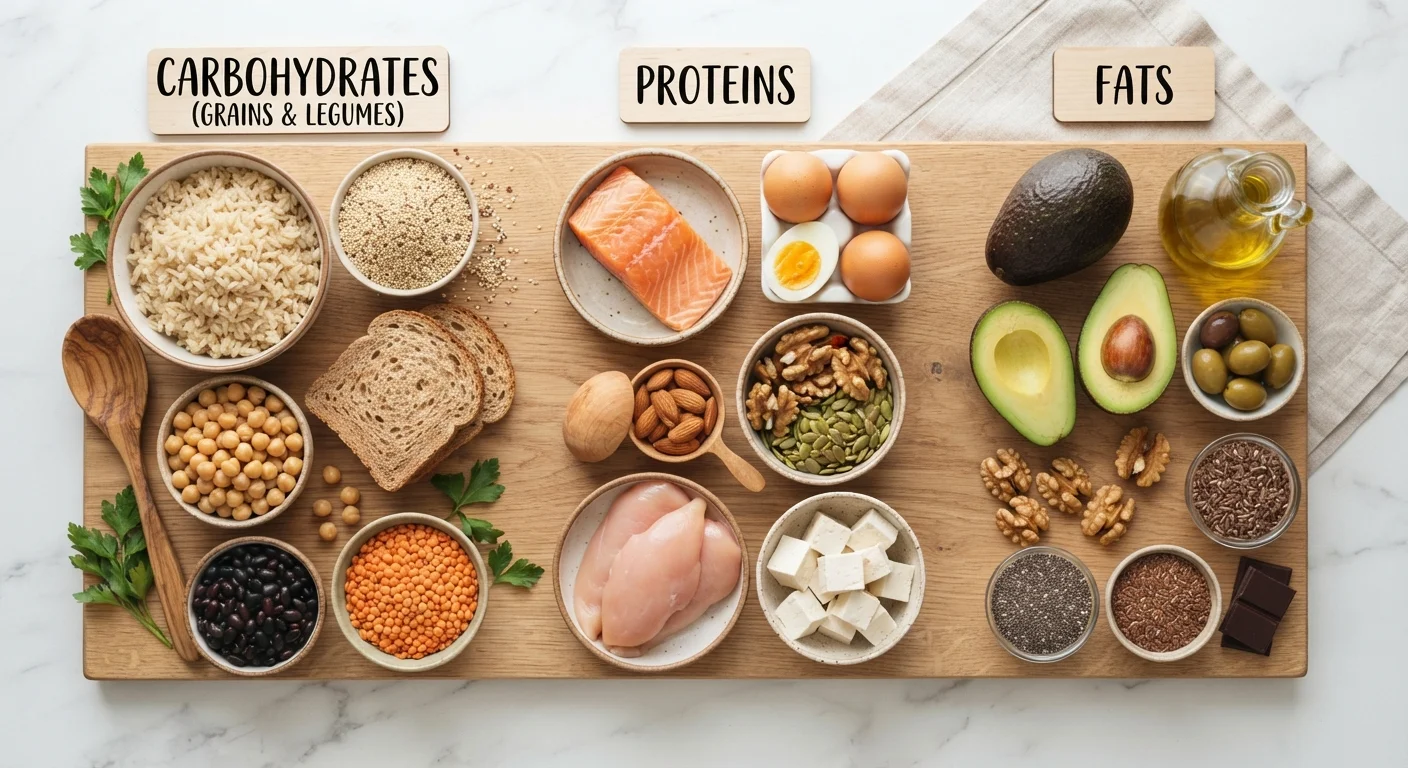
Macronutrients are the three main categories of nutrients your body needs in relatively large amounts every day: carbohydrates, proteins, and fats. Unlike vitamins and minerals, which are needed in tiny quantities, macronutrients supply the energy and raw materials your body uses to function, grow, and repair itself. Every food you eat contains at least one of them - and most contain a mix of all three.
Each macronutrient provides a distinct caloric density: carbohydrates and proteins provide 4 calories per gram, while fats provide 9 calories per gram. This is why fat-rich foods are more energy-dense, not inherently harmful.
Carbohydrates: Your Body's First Choice for Fuel
When you eat bread, fruit, beans, or oats, your digestive system breaks down the carbohydrates in those foods into glucose - a simple sugar your cells use as their primary energy source. Your brain alone relies almost exclusively on glucose to function, which is why low-carb eating can sometimes cause mental fogginess, especially early on.
Not all carbohydrates work the same way. Refined carbs (think white bread or sugary drinks) are digested quickly and can cause rapid swings in blood sugar. Whole-food carbs - found in vegetables, whole grains, and legumes - are digested more slowly, partly because they contain fiber. That slower release helps sustain energy and keeps you feeling fuller longer. For a closer look at fiber's outsized role, see why fiber matters more than most people realize.
A Simple Way to Think About Carb Quality
If a carbohydrate comes packaged with fiber, water, or other nutrients - as it does in whole grains, fruits, and legumes - it's generally a more nourishing choice than one that's been stripped down during processing. You don't need to count grams; just notice whether the food is close to its natural form.
Proteins: The Body's Builder and Repair Crew
Proteins are made of smaller units called amino acids, and your body uses them as structural material for almost everything: muscle tissue, skin, enzymes that drive chemical reactions, antibodies that support your immune system, and hormones like insulin. When you eat protein-rich foods - eggs, fish, chicken, tofu, lentils - digestion breaks those proteins into individual amino acids that your body then reassembles according to its current needs.
There are nine essential amino acids your body cannot manufacture on its own, which means they must come from food. Animal proteins typically contain all nine. Plant proteins vary, but eating a diverse range of plant foods throughout the day generally covers all essential amino acids without the need for precise meal-by-meal pairing.
~17%
Of the human body is made of protein
According to general physiology references, protein accounts for roughly 17% of total body weight, underscoring how central it is to bodily structure.
9
Essential amino acids humans must get from food
The National Institutes of Health identifies nine amino acids that the human body cannot synthesize on its own and must obtain through dietary sources.
Fats: Far More Than Just Stored Energy
Dietary fat has spent decades unfairly cast as the nutritional villain - and that reputation has left many people confused. In reality, fat performs critical functions that no other macronutrient can replicate. It forms the membrane of every cell in your body, supports the production of sex and stress hormones, cushions your organs, and is essential for absorbing vitamins A, D, E, and K, which are fat-soluble and simply pass through your system without it.
Fats are categorized broadly as unsaturated (found in olive oil, nuts, avocado, and fatty fish), saturated (found in meat and dairy), and trans fats (largely from industrial processing and widely advised against). Current nutrition research suggests focusing on unsaturated fat sources while limiting trans fats - though the full picture is nuanced. If you've heard that eating fat makes you gain weight or clogs arteries automatically, that's worth re-examining. Common nutrition myths often distort how we think about this macronutrient.
Fat Recommendations Have Evolved Over Time
Dietary guidelines around fat have shifted considerably over the past few decades as research has developed. Blanket advice to eat 'low fat' has largely given way to guidance emphasizing fat quality over fat quantity. Because nutrition science continues to evolve, it's worth checking current resources from established health organizations rather than relying on older rules of thumb.
Why All Three Work Together - Not Against Each Other
The idea that one macronutrient is good and another is bad oversimplifies how nutrition actually works. Your body uses carbohydrates, proteins, and fats in coordination: carbs fuel immediate activity, protein handles repair and structure, and fat manages longer-term energy storage and cellular function. Removing any one of them entirely creates trade-offs - your body compensates, but not always efficiently or without side effects.
A sustainable, evidence-informed approach focuses on food quality and variety rather than elimination. Whole foods tend to deliver a natural balance of macronutrients alongside the vitamins and minerals your body also needs. Speaking of which, vitamins and minerals work alongside macronutrients in ways that are worth understanding. And if you're curious how all of this connects to the concept of caloric energy, energy balance is more complex than it first appears.
This article is for general informational and educational purposes only and is not a substitute for professional medical or dietary advice. Please consult a qualified healthcare provider or registered dietitian for guidance specific to your health needs.
“Food is not just fuel. It is information. It talks to your DNA and tells it what to do. The most powerful tool to change your health is your fork.”
— Mark Hyman, Physician and author focused on functional medicine and nutrition